
1 min read
Why Learning Impact Fails Without Reliable Delivery and Facilitation
 Karen Vieth : Mar 16, 2026, 8:30:00 AM
3 min read

Live learning is chosen because people learn best with people.
That belief is tested the moment delivery becomes unpredictable. Sessions start late while someone troubleshoots audio. Facilitators juggle teaching and technical support at the same time. Materials are revised between cohorts because something “didn’t land.” Delivery teams find themselves monitoring programs that were supposed to run smoothly on their own.
When outcomes vary from one cohort to another, the human advantage becomes difficult to defend.
Over the past month, we have explored a critical reality: The quality of live learning does not depend primarily on content or intent. It depends on whether expert delivery is built into the system rather than activated only when problems arise.
The human edge is not charisma, it's the ability to produce consistent performance across sessions, facilitators, and environments.
Across many programs, the same patterns appear when delivery quality begins to wobble:
Breakdowns usually surface first during the session itself. Programs may look sound on paper, but facilitators end up managing content, engagement, and technology simultaneously.
Variance across cohorts also becomes visible quickly. One group finishes energized while the next runs long, skips activities, or struggles to complete key practice moments.
Late intervention becomes the norm. Delivery teams fix problems during or after sessions instead of preventing them through preparation, clear roles, and consistent standards.
When delivery conditions hold, teams can focus on learning rather than troubleshooting. When they do not, even well-designed programs require constant recovery work.
Reliable delivery shows up in everyday operational details.
Programs supported by coordinated facilitation, production, and design roles tend to produce comparable outcomes across facilitators and locations. Sessions begin on time because readiness checks are built into preparation. Activities run as designed because materials have been tested in the actual delivery environment. Facilitators focus on guiding discussion and application instead of managing logistics.
Escalations decline because problems are prevented earlier in the process. Preparation becomes more predictable. Post-session data becomes easier to interpret because differences between cohorts are no longer driven by delivery instability.

Many facilitators find it helpful to periodically assess their own delivery practices. Tools like our Top 19 Essential Virtual Facilitation Skills Self Assessment help facilitators identify which behaviors support consistent delivery and where adjustments may improve reliability across sessions.
These improvements affect more than the learning moment itself because they influence how confidently teams can plan programs, schedule facilitators, and scale delivery across multiple cohorts.
Protecting live learning quality requires deliberate shifts in how programs are prepared and supported.
Shift from Heroics to Standards
Many programs rely on particularly strong facilitators to compensate for gaps in preparation or structure. While this can create strong individual sessions, it rarely produces consistent results.
Shared delivery standards make expectations visible and repeatable. Facilitators know what practices must occur in every session, regardless of who is leading.
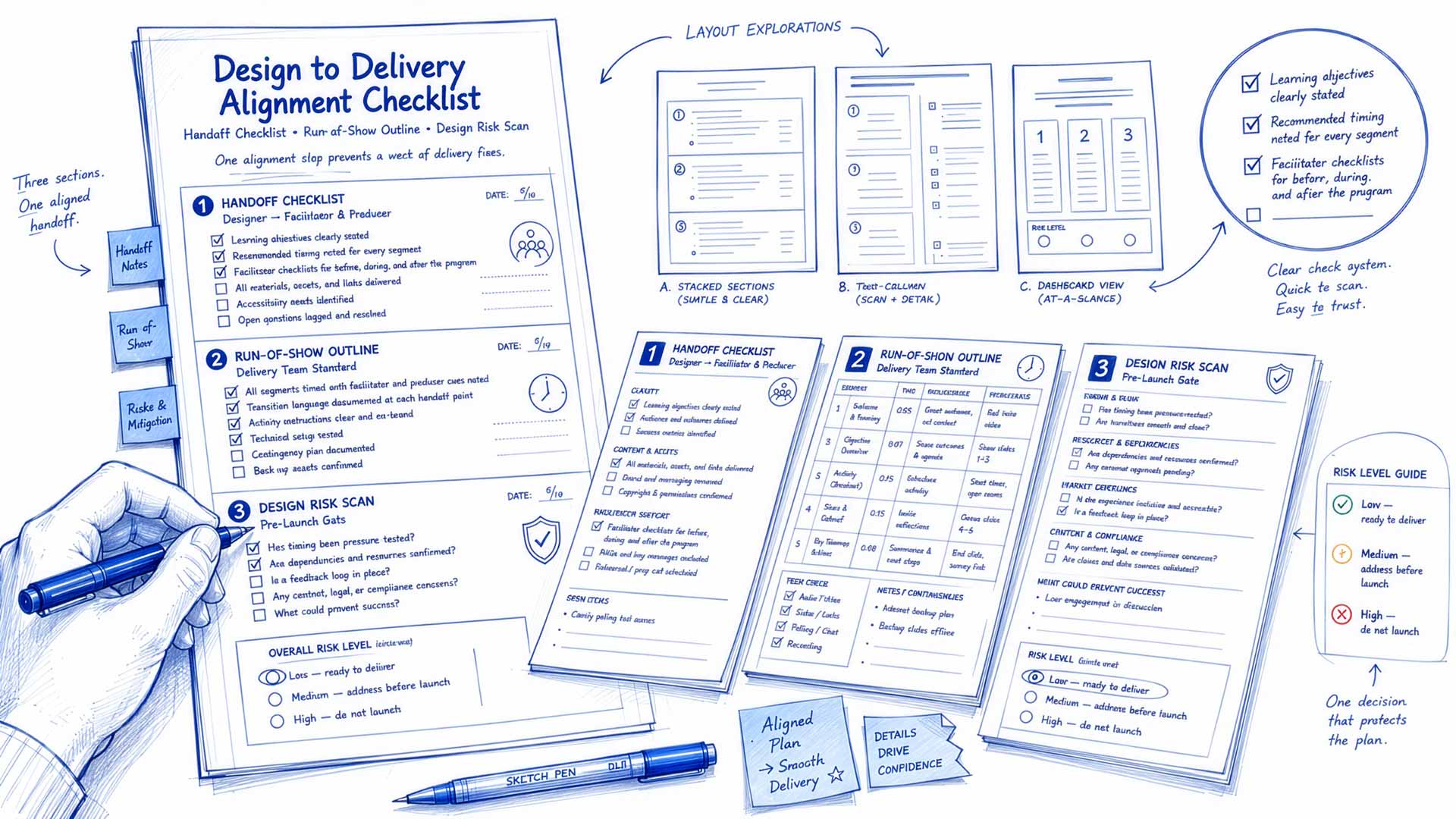
Practical Step: create a minimum delivery standards checklist covering facilitation practices, timing expectations, technology readiness, and participant support.
Shift from Capacity Stretching to Delivery Systems
As demand increases, organizations often ask existing staff to absorb additional sessions. Over time this compresses preparation windows and increases facilitator fatigue.
Reliable scale requires defined delivery roles that protect the learning environment. Production support, for example, removes many operational distractions that facilitators otherwise manage during sessions.
Practical Step: establish a producer coverage model and assign responsibility for readiness checks, platform setup, and live technical support.
Shift from Engagement Tactics to Engagement Frameworks
Individual techniques can energize a session, but results vary widely when engagement depends on facilitator style alone.
Shared engagement frameworks provide consistent participation structures learners encounter regardless of who is facilitating.
Practical Step: adopt a common engagement model, such as the InQuire Engagement Framework™, and integrate it into facilitator preparation and design templates.
Shift from Delivery Events to Delivery Environments
Live learning succeeds when the environment supports practice and application from start to finish.
Production support in virtual and hybrid settings, along with quality assurance across modalities, ensures that delivery conditions remain stable across cohorts.
Practical Step: introduce structured Quality Assurance steps such as dry runs in the actual platform, environment checks before sessions begin, and post-session reviews that identify emerging delivery risks.
The human edge in live learning is not a philosophical preference, it is a performance advantage.
When facilitators, producers, and instructional designers operate as an integrated system, delivery becomes predictable enough to scale and stable enough to trust. Delivery teams spend less time rescuing sessions and more time improving the learning experience itself.
If delivery quality feels fragile, the first step is identifying where instability enters the system. Watch for signals such as facilitators troubleshooting technology during sessions, compressed preparation windows between cohorts, or repeated adjustments to activities that were originally designed to run consistently.

Attend ‘Keeping Live Learning Impactful Under Pressure’ live, or watch the replay to learn delivery skills that keep live learning consistently engaging, inclusive, and impactful across regions and leave with a clear view of what to strengthen next.

1 min read
Karen Vieth : Mar 16, 2026, 8:30:00 AM
1 min read
 Jennifer Lindsay-Finan : Jun 8, 2026, 8:00:02 AM

1 min read
Jennifer Lindsay-Finan : Apr 13, 2026, 8:30:00 AM