
 Karen Vieth
1 min read
Hybrid Learning Design Under Pressure: Safeguarding Engagement and ROI
 Jennifer Lindsay-Finan : Nov 24, 2025, 8:30:00 AM

Live learning is chosen because leaders expect it to change how people think and act. That belief only holds when learning is designed to survive beyond the session itself.
Learning teams recognize that instructional design is critical. Clear outcomes, purposeful activities, and sound structure are what make live instruction viable in the first place.
Where learning impact weakens is not because design is absent, but because it often stops at the formal learning moment. When intent is not defined to carry forward into application, reinforcement, and real work conditions, even strong design struggles to produce durable performance.
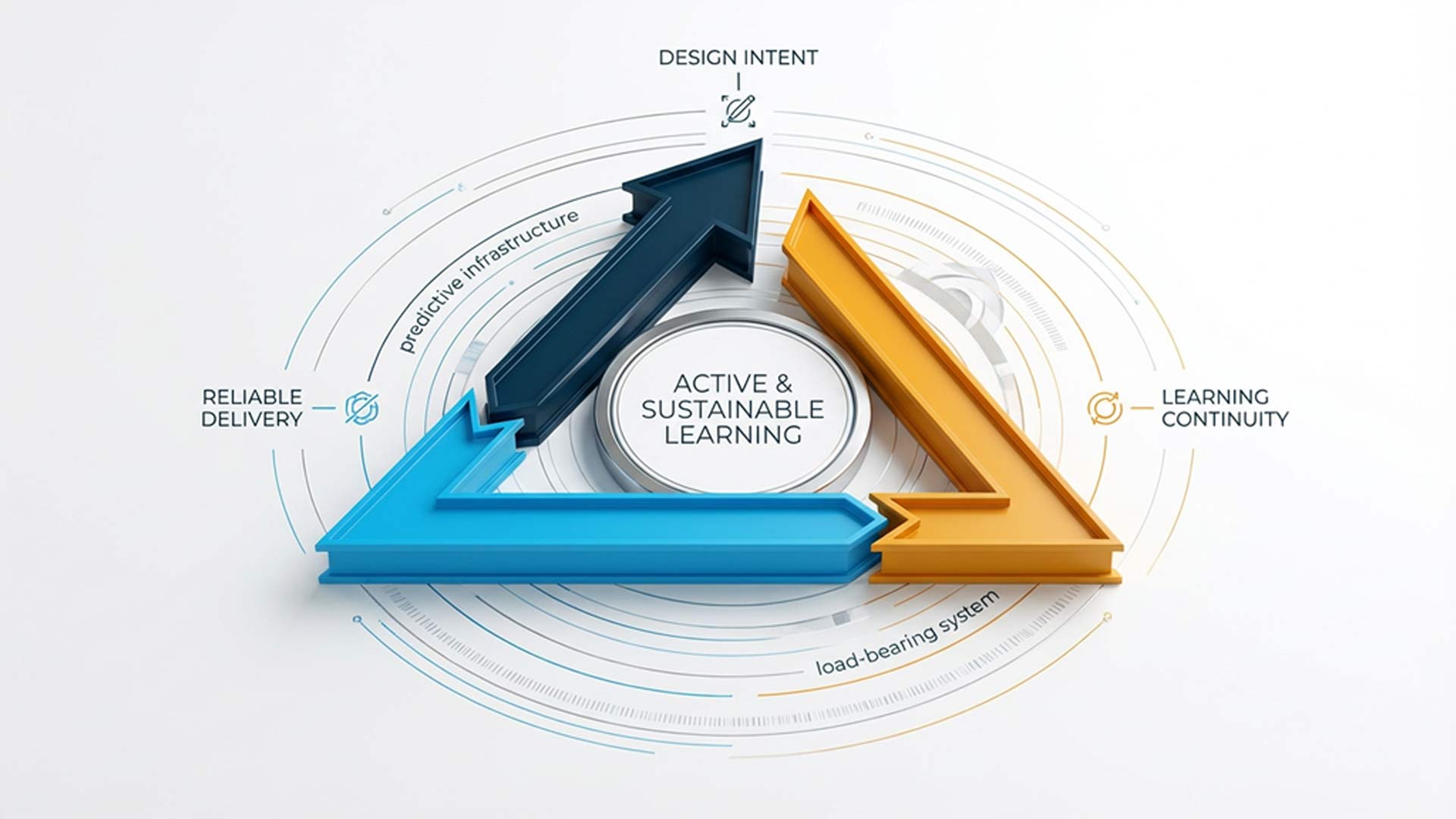
The Live Learning Formula exists to protect one outcome: learning that is active in the moment and sustainable over time.
Introduced in The Live Learning Formula: Why Learning Impact Depends on the System, the framework explains why learning impact breaks when design, delivery, and continuity are treated as separate efforts rather than as a single system under pressure.
Design & Development is one side of the Live Learning Formula because it determines whether learning can hold once delivery begins. Design defines what must change and what success will look like. When intent is not clear enough to survive delivery and reinforcement, every other part of the system is forced to compensate.
This is why learning impact so often fractures long before delivery begins. Many organizations don’t struggle because learning is ineffective in the moment. They struggle because no one can confidently say what changed afterward.
Design is often treated as preparation. A necessary step before facilitation, production, or rollout begins. But within the Live Learning Formula, design is not upstream work. It is load-bearing work.
Design determines what the learning is responsible for producing and what the organization will later expect to see change. It's not what will be covered or what activities will be included. It's what learners should be able to do differently once the session is over and enough time has passed for real work to intervene.
When that intent is clear, delivery has something stable to activate. When it is not, even strong facilitation and polished experiences struggle to produce consistent results.
Engagement is often asked to carry more weight than it should. When outcomes are vague, teams lean harder on interaction, energy, and activity to create impact.
The result is motion without evidence.
For practitioners, this is the moment where better questions and better engagement design prevent “motion without evidence.” At our Turn Live Engagement Into Proof You Can Use practitioner’s webinar, we share how facilitators and designers how to use the InQuire Engagement Framework® to turn questions, polls, and discussions into observable indicators of progress. Paired with our Question Framing Guide, these techniques help ensure that engagement produces data that holds up after delivery.
Engagement amplifies whatever design makes possible. If intent is unclear, engagement increases participation without producing reliable behavior change. Sessions feel active, learners contribute, and Energy is visible. But what changes afterward is difficult to name, measure, or reinforce.
When outcomes aren’t clear, teams often compensate by adding more interaction, more tools, or more complexity. This shift—from intent to activity—mirrors the trap described in Instruction First, Tech Second, where delivery decisions begin to lead instead of instructional purpose.
This is not a facilitation problem. It is a design signal showing up downstream.
Oftentimes instructional design focuses on intellectual engagement. Do learners understand the concepts? Can they explain the model? Do they recognize the language?
This distinction matters because most learning is evaluated at the point of understanding, not at the point of use.
Understanding matters.
But understanding alone rarely survives the moment people have to decide what to do next.
Readiness requires more than cognitive clarity. It includes emotional commitment and the confidence to try something new in real conditions, not just ideal ones. Learners may understand what good looks like and still hesitate when stakes rise, time compresses, or expectations shift in real work.
This is where design decisions quietly determine whether learning holds. If learners are never asked to wrestle with tradeoffs, practice judgment, or anticipate resistance, understanding remains fragile. It does not travel well into real work.
Learning that holds is designed to stretch beyond recognition and recall. It prepares learners for the moment they must decide whether to apply what they learned or revert to familiar habits.
This is also why InSync’s InQuire Engagement Framework™ (IQF) treats intellectual, emotional, and environmental engagement as design decisions as well as facilitation techniques. Readiness depends on what learners understand, how safe they feel, and whether the environment supports real application, not just recall.
Psychological safety is often attributed to facilitator skill because facilitation matters. However, safety is largely established before the session begins.
It is shaped by how practice is designed and by how risk is calibrated. Are learners expected to experiment, reflect, and make mistakes without penalty?
Design choices that account for learner variability, access, and confidence, such as those grounded in inclusive design and Universal Design for Learning, play a structural role in emotional and environmental engagement long before delivery begins.
Design sets the boundaries for safety. Delivery can only operate within what design makes possible.
If learners are not designed into safe attempts, emotional engagement becomes fragile. Participation may continue, but confidence erodes as soon as conditions change. These moments matter precisely because learning is social. People decide whether to apply new behaviors while being seen, evaluated, and influenced by others.
One reason learning impact fades after delivery is that many experiences are designed for instruction, not for use. This is where design either carries learning forward or lets it collapse under real conditions.
This gap is especially visible in hybrid learning environments, where some participants are co-located while others join remotely and the learning experience must hold across locations, technologies, and power dynamics. When design intent does not anticipate those conditions, learning may feel complete at delivery while remaining fragile in practice. Outcomes are understood, but not durable.
The 5 Moments of Need model, developed by Bob Mosher and Conrad Gottfredson and outlined at 5momentsofneed.com, offers a useful lens here. Learners do not stop needing support when instruction ends. They encounter moments of application, problem-solving, and change well beyond the live experience.
When design intent does not anticipate those moments, learning may feel complete at delivery while remaining fragile in practice. This is why durable blended learning connects live instruction to follow‑up practice and microlearning as part of the original design, rather than treating reinforcement as an afterthought.
Design does not execute sustainability. But it determines whether sustainability is possible.
Unclear intent shows up downstream in predictable ways.
Facilitators improvise emphasis because outcomes are open to interpretation. Producers and delivery teams focus on stability and pacing, trying to create consistency where intent did not. Support and continuity efforts inherit ambiguity and are forced to invent meaning after the fact.
Over time, this compensation becomes invisible labor absorbed by facilitators, producers, and support teams. Teams work harder, not smarter. Quality depends on experience, heroics, or institutional memory rather than on a system leaders can trust.
This is often misdiagnosed as a facilitation or engagement issue, but in reality, it is a design issue surfacing later in the system. When intent is not clear enough to hold, every other pillar absorbs the strain.
Clear design does not guarantee learning impact, but it makes impact defensible.
When intellectual, emotional, and environmental engagement are designed with intent, delivery becomes more reliable. Reinforcement has something concrete to reconnect to. Measurement becomes possible without guesswork. At that point, leaders can evaluate learning using shared standards and diagnostic resources rather than intuition alone, making it easier to identify where design, delivery, or continuity needs attention.
Practitioners reinforce this defensibility through consistent measurement practices. 10 Must-Have Tools for Measuring Learning Impact provides practical ways to collect, document, and analyze the evidence leaders rely on when evaluating whether design intent is holding across cohorts and conditions.
Design is one side of the Live Learning Formula. But when intent doesn’t hold, no amount of delivery excellence or post-session support can restore learning impact.
The next side of the triangle, Delivery and Facilitation, examines what happens when clear design intent meets real-world execution across facilitators, cohorts, and delivery modalities. Even strong intent cannot produce reliable learning impact if delivery conditions do not hold consistently at scale.
If learning outcomes vary by cohort, facilitator, or region, the problem may not be delivery at all.
It may be that design intent is not built to hold once real work intervenes.
Start with our Live Learning Impact Diagnostic to see where intent fractures across design, delivery, and continuity.
Then join our webinar Turn Live Engagement Into Proof You Can Use to see how organizations are restoring confidence in learning impact at scale.

1 min read
Jennifer Lindsay-Finan : Nov 24, 2025, 8:30:00 AM
1 min read
 Karen Vieth : Mar 2, 2026, 8:30:00 AM
1 min read
Karen Vieth : Jun 1, 2026, 8:00:04 AM