
 Karen Vieth
1 min read
Hybrid Learning Design Under Pressure: Safeguarding Engagement and ROI
 Jennifer Lindsay-Finan : Nov 24, 2025, 8:30:00 AM
Learning Leadership Series

Karen Vieth
CEO, InSync Training
There's a particular moment I've been in more times than I can count. The program wrapped well. The facilitators were prepared. Participants engaged. And then, a few weeks later, someone in a budget review asks the one question the data can't answer: Did it actually change anything?
You pull up the evaluation report. Completion: 94%. Satisfaction: 4.2 out of 5. And you watch the room go quiet in a way that has nothing to do with the numbers being bad.
If you've been in that budget meeting, you already know the silence isn't about bad data.
The numbers just don't answer the question.
I've been in that room for 25 years. What I've learned is that the silence isn't about bad data. It's about the fact that everyone is trying to answer a business question with learning data. Did people lead differently? Did behavior change? Did performance improve? Most of the time, the answer isn't sitting in the evaluation report because the conditions required to answer those questions were never built into the learning experience in the first place.
The organizations I've worked with that struggle to demonstrate the value of their live learning programs almost always share the same root condition: they are trying to measure outcomes that the learning system was never intentionally designed to produce. They designed the learning experience carefully, ran it well, and measured exactly what their evaluation framework was built to measure.
The problem is that most evaluation frameworks were designed to track activity. Completion. Attendance. Satisfaction. Those are real things worth knowing. But none of them answer the question being asked in the budget meeting.
According to LEO Learning and Watershed research, the pressure to prove value significantly outweighs the metrics being tracked.
According to LEO Learning and Watershed, 70% of L&D leaders are under increasing pressure to prove the value of their programs. Only 48% measure anything beyond completion. I find that number unsurprising. The problem isn't that learning teams aren't measuring. The problem is they're being asked to prove something the program was never designed to support.
After decades of watching programs succeed and fail at this, the signal I look for first isn't the evaluation instrument. It's what happened before the session was designed.
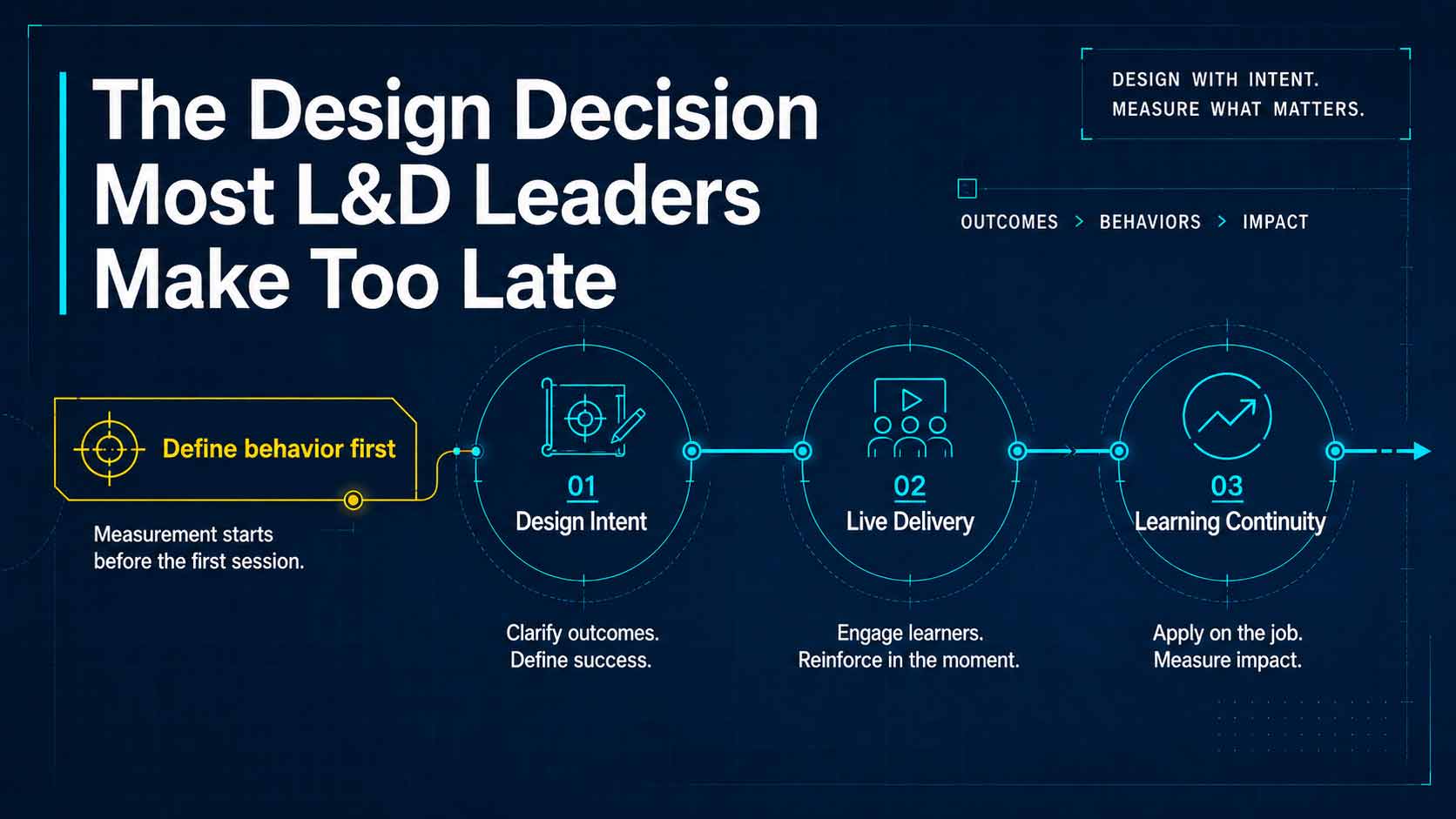
The organizations that can demonstrate impact almost always started with a specific behavioral question: what do we need people to do differently, and when will we know if they're doing it? That question shapes everything downstream — how the program is designed, how the session is facilitated, and what needs to be in place in the 30, 60, and 90 days after the learning ends.
The organizations that can't demonstrate impact usually started with a topic. Sometimes a competency. Rarely a behavior, and almost never a timeline for observing it.
I've watched organizations spend six figures on a live learning program and then have nothing to say at the six-month review except “people liked it.” That outcome was predictable, and it was set in motion by a leadership decision, not a design failure — the day the design conversation started with “what should we cover” instead of “what do we need people to be able to do.”
Here’s what I’ve learned about why learning succeeds or fails to create lasting change: the problem almost never lives where the team thinks it does. When L&D practitioners come to me frustrated that their data doesn’t answer impact questions, the instinct is usually to look at the evaluation instrument. Better surveys. More rigorous pre- and post-assessments. A different scoring rubric.
Those changes rarely help. Because the gap isn’t in the measurement moment. It’s in what came before it.
If the design didn’t specify a behavioral outcome, the evaluation has nothing real to measure.
If the delivery didn’t prepare participants to apply what they learned, transfer won’t happen and no follow-up survey will capture what isn’t there.
If nothing was in place in the 90 days after the session — manager check-ins, application exercises, structured reinforcement — then the learning disappeared in the ordinary pressure of work, and no metric will surface it.
What I’ve come to call the Live Learning Formula isn’t a model I developed in the abstract. It’s a description of what I kept seeing in the programs that worked: design intent that specifies a behavioral outcome, delivery that prepares people to apply rather than just absorb, and learning continuity in the weeks that follow. When all three are in place, you create the conditions for learning to become performance. Measurement becomes possible because meaningful change has something real to measure. When any one of them is missing, the gap isn’t a surprise. It was built in.
The organizations I’ve seen create lasting behavior change share one quality: they treat the measurement conversation as a design conversation, not an evaluation conversation. They ask what success looks like before the program is built. They design the follow-through into the program from the start rather than trying to retrofit accountability afterward.
That shift sounds simple. In practice, it requires every stakeholder — learning design, facilitation, management, operations — to be aligned on what the learning is supposed to produce. That alignment is harder to create than a better survey. It’s also the only thing that actually moves the number.
The measurement conversation is not an evaluation problem. It is a design problem that belongs to you before the program is built. The leaders who close the gap between learning activity and business outcome are not the ones with better dashboards — they are the ones who asked what success looks like before anyone opened an authoring tool and built the conditions for it from the start.
The Why Go Live White Paper makes that case in full — the evidence base, the case studies, and a practical model for designing live learning that produces outcomes worth measuring.
Explore the evidence base, the case studies, and a practical model for designing live learning that produces outcomes worth measuring.
Read the White PaperKaren Vieth is the CEO of InSync Training. With 25 years of experience building and evaluating live learning programs for global organizations, she works with L&D leaders on the gap between learning activity and the business outcomes their stakeholders need to see.

1 min read
Jennifer Lindsay-Finan : Nov 24, 2025, 8:30:00 AM

1 min read
Jennifer Lindsay-Finan : Nov 10, 2025, 8:00:00 AM

1 min read
Jennifer Lindsay-Finan : Jun 9, 2025, 8:00:00 AM