
 Jennifer Hofmann
1 min read
Virtual Classroom: Upping the Social, Bringing More Human Presence
The last post explored the importance of making connection: bringing more meaningful learning experiences while alleviating today’s workforce...

Jane Bozarth’s new “Adaptive Enterprise Framework” shines a light on opportunities for learning practitioners to operate into the spaces around and between formal learning events. Watching colleagues be laid off due to being replaced by AI—and then rehired within just a few months—Bozarth saw that in nearly every case the organization realized too late what humans brought to the table that AI could not replicate: things like empathy, flexibility, judgment, and ethical decision making. While AI can be trained to mimic those things, reality (and in some cases outright customer revolt) showed that mimicking was not always enough.
by Jane Bozarth
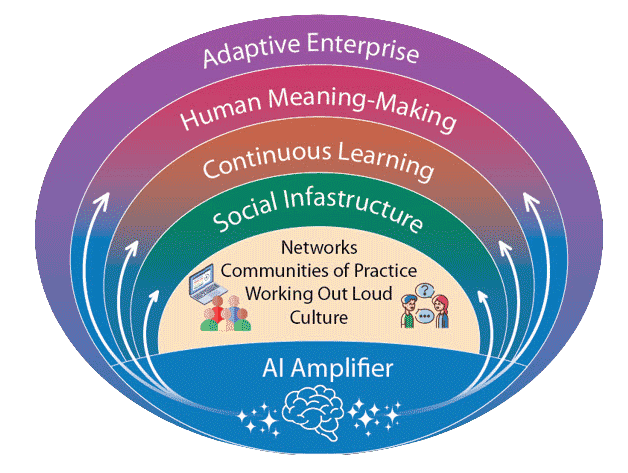
The big questions: What do humans bring to organizations, and how can we as learning practitioners support them? First, humans provide Social Infrastructure, made up of the activities and spaces where workers interact and share information about practices, problems, solutions, and the like, supported by a culture that allows that. This space is where knowledge and information travel around the organization.
Layered on top of social infrastructure we complete the picture of Continuous Learning in the organization with things that can be managed and measured, like LMSs, LRSs, job aids, and formal training/learning initiatives.
Beyond that is Human Meaning-Making, where social infrastructure and continuous learning meet, and workers make decisions, take judgment calls, deal with barely repeatable processes, and grapple with ethical conundrums.
L&D supports the social infrastructure layer by intentionally designing the conditions under which knowledge, judgment, and learning flow through the organization.
This includes seeding and sustaining communities of practice where peers exchange real AI use cases and refine work habits together; creating lightweight mechanisms that make experimentation, prompts, and lessons learned visible and reusable; embedding simple reflection rituals such as learning reviews and decision retrospectives to strengthen judgment; equipping managers to foster psychological safety for responsible experimentation; and engineering boundary-spanning connections that help insights spread across teams. By architecting these participation patterns — not just delivering content — L&D strengthens the human system that allows AI capability, innovation, and ethical decision-making to scale.
Support continuous learning and human meaning-making via facilitated learning experiences that provide for real dialogue and conversation around dilemmas, not just “topics”: intentionally-ambiguous scenarios and skill practices (people can’t practice judgment if everything in training is clear-cut). Help learners spend more time thinking than just consuming. Work toward helping them make sense rather than just “transfer” knowledge. Help them interpret, apply, and adapt it wisely rather than pass a perfunctory quiz on it.
If your organization is adopting/integrating AI, use it to
And work with learners to take those options and make decisions about them.
Learn More: Listen To Jane Bozarth and David Kelly in their Podcast The Future of Learning Is More Human, Not Less
Coming next: Social is Back: The Resurgence of Instructor-Led Experiences

1 min read
The last post explored the importance of making connection: bringing more meaningful learning experiences while alleviating today’s workforce...

1 min read
 Karen Vieth : May 19, 2025, 8:00:00 AM

1 min read
I’m a huge proponent of self-paced online learning and can trace my enthusiasm back to 1999 when my first graduate course was offered online. In...