
 Jennifer Hofmann
1 min read
Live Learning Delivery Capability: Does Your Organization Have It?
 Jennifer Hofmann : Aug 3, 2026, 7:00:01 AM
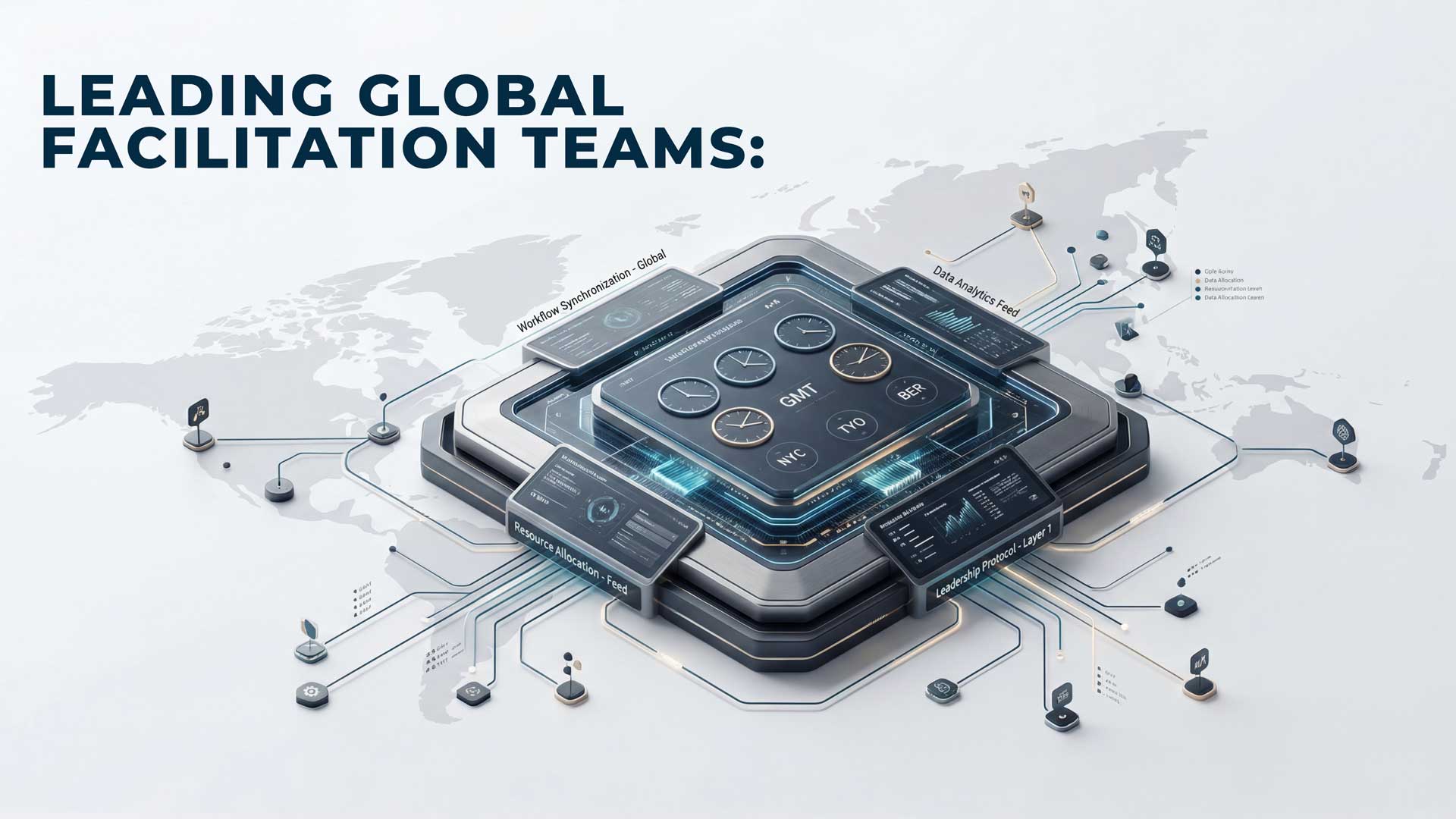
Leading a global facilitation team is one of the most complex leadership challenges in L&D today — and one of the least discussed.
Most leadership literature focuses on leading people who build things, sell things, or run operations. Very little addresses what it means to lead professionals whose entire expertise is enabling other people to learn, connect, and change. Add virtual, hybrid, in-person, and global delivery into the equation, and you have a job that demands a rare combination of operational rigor, cultural intelligence, and deep conviction about what human-led learning actually does that technology cannot.
This article is for L&D and OD leaders who are living that complexity every day. It is grounded in more than two decades of experience building and leading global facilitation teams, research on where the field is headed, and a clear-eyed look at what the job actually requires.
The short answer: it evolved faster than the leadership models designed to support it.
For most of the twentieth century, corporate facilitation meant one thing. A person stood at the front of a room. They delivered content. Participants received it. The classroom was the default, and instructor-led training was the only serious model on the table.
That started to change in the late 1990s. The rise of e-learning promised scale, cost savings, and reach. Organizations rushed to put everything online, often with more enthusiasm than evidence. The result was a generation of linear, self-paced courses that technically worked but frequently failed to change behavior. The field began to recognize that something was missing.
Blended learning emerged as the answer — the idea that no single modality does everything well, and that thoughtful combinations of live and asynchronous learning could produce better outcomes than either alone. That thinking was formalized and given language in the early 2000s, including through foundational texts that practitioners still reference today.
At InSync Training, we were not watching this evolution from the sidelines. We were building the infrastructure for it. In 2000 — before most of the industry had language for what virtual training even was — we began developing the frameworks and practices that would define synchronous virtual learning. When the pandemic arrived in 2020, organizations that had spent years treating virtual delivery as a backup option suddenly needed it as their primary one. Teams that had invested in the discipline were ready. Many others were not.
Today, the landscape is more complex than any single moment in that history. Virtual, hybrid, in-person, and global delivery are not sequential phases. They are simultaneous realities. A facilitation team operating at scale must be competent in all of them, often within the same program, sometimes within the same week. The leader of that team carries a responsibility the field has not fully caught up to.
Before we can talk about what great leadership looks like, we need to name what the job actually contains. There are four distinct dimensions of complexity that leaders of global facilitation teams navigate simultaneously.
Modality complexity. Virtual, hybrid, and in-person delivery are not simply different rooms. They require different facilitation skills, different producer support structures, different engagement strategies, and different approaches to managing group dynamics. More than 123 million hybrid events took place in 2025 alone, making hybrid the fastest-growing segment in the industry. Today, 81% of employees prefer hybrid or fully remote arrangements. The office itself is shifting from a daily default to a purpose-built venue for collaboration — what researchers now describe as a magnet rather than a mandate. For facilitation teams, that shift reframes not just where sessions happen but why in-person delivery is chosen at all. The leader must build a team that is genuinely proficient across all modalities.
Cultural complexity. Global teams bring time zones, communication norms, power distance, and language differences into every session. Research from Thunderbird School of Global Management confirms that managing globally across cultures presents a complex set of challenges arising from differences in values, communication styles, norms, and expectations. A facilitation team leader must build cultural intelligence not just as an individual competency but as a deliberate team capability.
Consistency complexity. How do you ensure that a learner in Singapore has an experience equivalent to a learner in Chicago, delivered by a different facilitator, in a different time zone, in a different modality? Consistency at scale is not a design problem alone. It is a leadership and systems problem. Quality does not happen when teams are stretched thin. It happens when delivery roles are protected, specialized, and supported.
Scale complexity. Demand for live learning does not grow in a straight line. Surges happen during product launches, organizational changes, and compliance deadlines. Without elastic capacity, organizations respond by overloading internal staff or compressing preparation time, both of which increase failure risk. Many L&D leaders have described the experience precisely: rising pressure on internal facilitators, reactive scheduling that pushes strategic work into nights and weekends, and the uneasy sense that important programs are getting out the door but not getting stronger.
McKinsey research has found that improved communication and collaboration through social technologies can raise productivity by 20-25% — but that potential is only reachable when the human infrastructure supporting it is strong enough to sustain the load.
Most leaders of facilitation teams are managing all four of these simultaneously. The wonder is not that it is difficult. The wonder is that it is treated as straightforward.
The pressure to move learning to self-paced, asynchronous, or AI-generated formats is real, constant, and often financially motivated. The leader of a global facilitation team has to be the person in the room who holds the line on what learning must remain live. That requires both intellectual clarity and organizational authority.
Session lengths have compressed dramatically. Research shows that 20 to 30 minutes is now the attention norm, with shorter focused sessions replacing full-day formats. That shift makes the decision about what deserves live time even more consequential. Not everything can or should compete for that window. The question is what genuinely requires it.
The research points to a clear decision framework. Live, human-led learning is required when:
Topics that belong in live, human-led learning: leadership development, conflict resolution, psychological safety, change management, onboarding culture and values, cross-cultural communication, coaching and feedback skills, and any compliance content with judgment dimensions.
Topics that can move to asynchronous or self-paced formats: policy and process knowledge transfer, technical systems training, foundational pre-work before a live session, binary compliance content, and microlearning reinforcement after live sessions.
Making this distinction clearly and defending it under budget pressure is one of the most important things a facilitation team leader does. It is not an instructional design choice. It is a strategic one.
The conversation about AI and learning tends to generate more heat than clarity. The honest position is this: AI is a powerful tool, and it is not a substitute for human facilitation. Understanding why requires being precise about what each does.
Connection is the mechanism, not the feature. AI delivers information. It can do so efficiently, at scale, and with personalization that self-paced platforms have never achieved. What it cannot do is create the moment when a learner feels genuinely seen, challenged, or supported by another human being. That moment is not a nice-to-have in learning design. It is often the mechanism through which behavior actually changes. Research consistently shows that 79% of employees do not trust AI to understand emotions or human behavior as well as their leaders can. The deepest learning still happens in human relationship.
AI amplifies what the system gives it. Dr. Jane Bozarth, Director of Research for the Learning Guild and a recognized voice in the field of social learning, is developing a framework that positions AI not as a driver of organizational learning but as an amplifier. Her emerging research describes three layers in healthy learning organizations: the social infrastructure where people talk, share, and build communities of practice; the structured continuous learning layer of formal programs and systems; and the human decision-making layer where judgment and meaning-making happen. AI, in her framing, accelerates whatever system it encounters. In organizations with rich human infrastructure, that acceleration produces powerful outcomes. In organizations where the human layer is thin or hollow, AI accelerates toward hollow outcomes faster. The amplifier needs something worth amplifying.
by Jane Bozarth
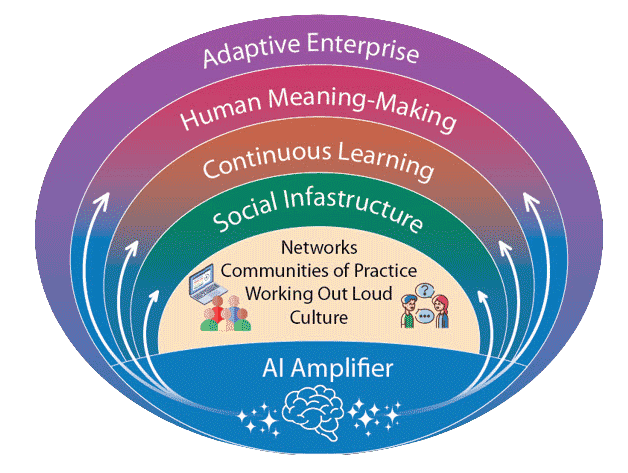
The broader L&D field is arriving at the same conclusion. The period from 2023 to 2025 felt like an AI gold rush, with pilots in every function and ambitious initiatives in every board presentation. By 2026, organizations face harder choices about where AI genuinely transforms outcomes versus where it simply adds speed without substance. Around 80% of employees are now using or experimenting with AI at work. The speed of that adoption has outpaced the governance structures designed to catch errors.
AI is not accountable. This is the point that does not get said often enough. AI does not know when it is wrong. It delivers errors confidently, fluently, and without any awareness that something has gone amiss. Research has documented AI hallucination rates in specialized domains ranging from 69 to 88 percent on certain query types. The errors do not announce themselves. They sound authoritative. A recent joint report from Wharton and Accenture put it directly: intelligence can be scaled. Accountability cannot.
While around 80% of employees are using or experimenting with AI at work, the technology struggles with fundamental requirements of effective facilitation: empathy and accountability.
A skilled facilitator feels when the room has lost the thread. They notice the participant who has gone quiet, the energy that has shifted, the moment when the content stopped connecting. They correct, adapt, and own the outcome. That is not a feature AI is close to developing. It is structural. When a facilitator gets something wrong, there is a person who is responsible, who knows they are responsible, and who has professional and reputational skin in the game. When AI gets something wrong, no one in the room feels it unless a human is watching carefully enough to catch it.
That distinction matters enormously when the learning involves compliance, safety, or anything where an undetected error carries real consequences for real people.
Understanding the complexity is necessary. Knowing what to do about it is the work.
You are leading professionals whose expertise is enabling others. This is not a minor distinction. Facilitators are trained to set aside their own agenda, create space for others, and subordinate their preferences to the needs of the group. Traditional management approaches built around directive authority and individual output measurement do not transfer well to this population. The leader of a facilitation team must model the very behaviors they expect from their facilitators: curiosity, active listening, psychological safety, and shared ownership of outcomes. This is recursive leadership, and it is harder than it sounds.
Consistency without uniformity. Facilitators bring different backgrounds, disciplines, and strengths. A facilitator with an HR background approaches group dynamics differently than one with an engineering or OD background. The leader's job is not to standardize those differences away. It is to build a system in which quality is reliable without flattening what makes each facilitator effective. That requires clear standards, shared frameworks, regular calibration, and enough trust to let skilled professionals work in their own voice.
Quality as a structural commitment. InSync Training is an IACET Accredited Provider, and that accreditation is not a credential on a wall. It is a continuous improvement discipline. IACET is the only standard-setting organization approved by the American National Standards Institute for continuing education and training. Accreditation requires demonstrating compliance with nine essential elements of quality, and reaccreditation is required every five years. For a facilitation team operating globally, that external accountability structure is one of the ways quality becomes systematic rather than aspirational.
Cultural intelligence as a team competency. Cross-cultural leaders build trust by being consistent and by creating small moments of clarity that remove uncertainty. A facilitation style that feels engaging in one culture can feel chaotic or disrespectful in another. The leader must build this awareness deliberately across the team, not simply assume it comes with experience.
Protecting the team from scale. When demand exceeds capacity, quality breaks before people do, but people break soon after. Rushed preparation, uneven facilitation, and inconsistent experiences show up in learner engagement before burnout becomes visible. The leader's job is to build or access the elastic capacity that allows programs to grow without those shortcuts. Shared capacity models, whether internal or through trusted partners, are not a temporary fix. They are a long-term operating model that allows programs to improve rather than simply survive.
The facilitator's role is being redefined upward, not downward. As AI handles more of the administrative, logistical, and content-delivery work, human facilitators become responsible for what only humans can do: relationship, judgment, accountability, and meaning-making. That is a more demanding role than the one many organizations currently recognize. Leaders who develop their teams for that future will have a significant advantage.
The market reflects the direction. The professional facilitation and training market stands at $2.19 billion in 2025 and is projected to reach $2.61 billion by 2030. Growth is not the question. The question is whether organizations will invest in the human infrastructure that makes that growth meaningful — or whether they will chase scale at the expense of quality.
The organizations that thrive in this environment will be those that treat learning as a continuous capability rather than a series of initiatives. By the time a change initiative is designed and launched, the change it was meant to address has often already moved on. The adaptive enterprise, as emerging research in the field describes it, builds learning into the fabric of daily work through strong human infrastructure, not through periodic rollouts. Facilitation teams are a critical part of that infrastructure. Leaders set the culture that makes it possible.
The question was never AI or humans. It was always what each does best. AI does certain things extraordinarily well. It scales. It personalizes. It finds patterns. It reduces friction. Human facilitators do other things that AI structurally cannot: they read rooms, build trust, hold space for complexity, and own the outcomes of their work. The organizations that make this distinction clearly, hold the line on it under pressure, and invest in the human infrastructure at the center of their learning strategy will be the ones whose learning programs actually change behavior.
That is the work. It has always been the work. What is new is the scale, the geography, and the clarity required to do it well.
InSync Training has been building and supporting global facilitation teams since 2000. From certified virtual facilitators and producers to managed learning services that scale across regions and modalities, we help L&D leaders deliver live learning that holds up under real conditions. Explore our facilitation and managed learning services at insynctraining.com.
1 min read
Jennifer Hofmann : Aug 3, 2026, 7:00:01 AM
1 min read
 Jennifer Lindsay-Finan : Apr 13, 2026, 8:30:00 AM
1 min read
Updated September 2026. The live virtual classroom facilitator is often defined as the leader and lesson guide, who instead of lecturing, provides an...