
 Karen Vieth

1 min read
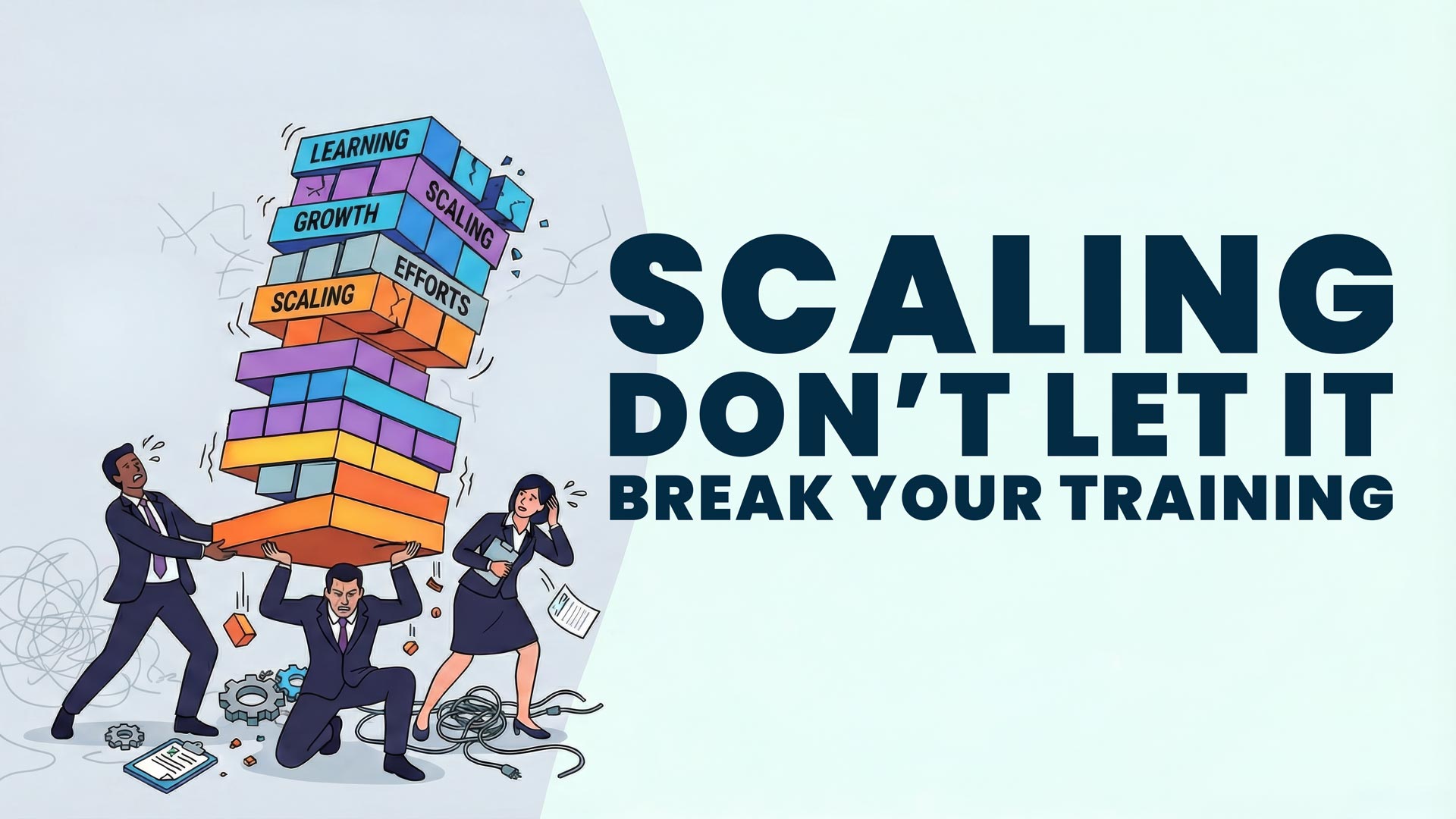
Live learning builds capability in ways content alone never will. Judgment, confidence, and shared understanding develop when people learn with and from one another in real time. But as training programs scale, those human elements are often the first to erode. It's not because teams stop caring, but because the systems supporting live learning were never designed to grow with it.
Many organizations are beginning to recognize that, in the push for speed and efficiency, we stepped too far away from quality live learning. One-way webinars, self-paced eLearning, and AI-generated content helped teams move fast and solved short-term delivery problems, but they also pulled learning away from something people are clearly craving again: meaningful interaction.
Strong, well-designed live learning creates connection, and that connection then builds judgment, confidence, and shared understanding in ways content alone cannot. When people learn with and from one another, capability develops faster and lasts longer. Human connection has become a competitive advantage and is what makes live learning harder to scale well.
Many L&D teams experience a brief sense of relief once capacity pressure eases. After months of strain, calendars stabilize, programs resume, and it can feel like the crisis has passed. But that relief often masks unresolved structural risk—exactly the kind of overload that quietly builds again if operating models don’t change.
And yet a quieter question has replaced the urgency:
How do we grow without breaking the team again?
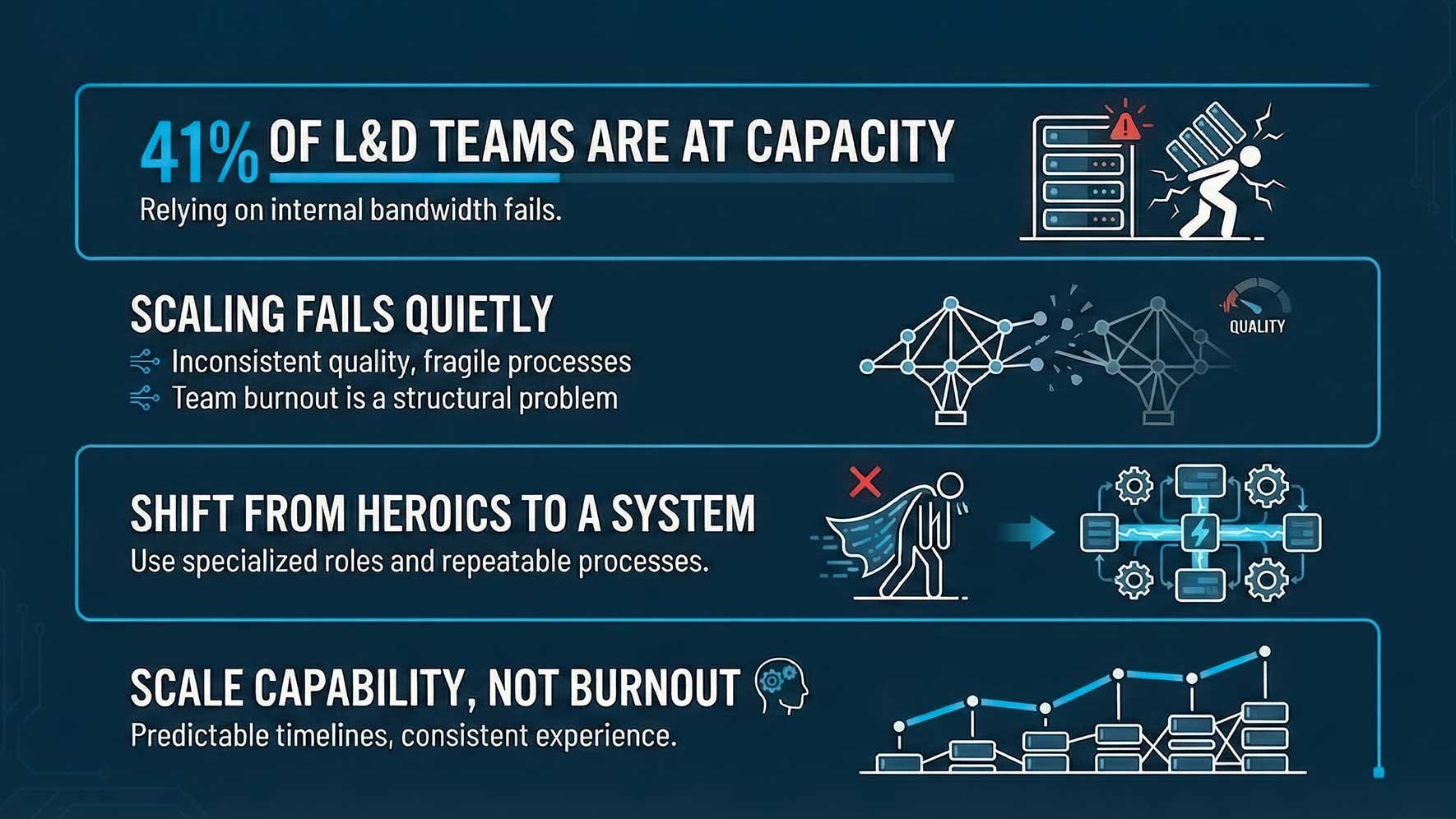
This question matters because live learning rarely fails in obvious ways. It fails quietly, as quality slips, connection erodes, and teams stay busy but lose the space to improve.
Why Effort Isn’t Enough to Scale Live Learning
When training programs expand—new regions, more cohorts, higher stakes—the first assumption is often that effort will close the gap. Teams work longer hours. Facilitators take on additional sessions, while producers and project managers juggle overlapping launches and designers compress timelines.
And for a time...it works.
Then the cracks appear.
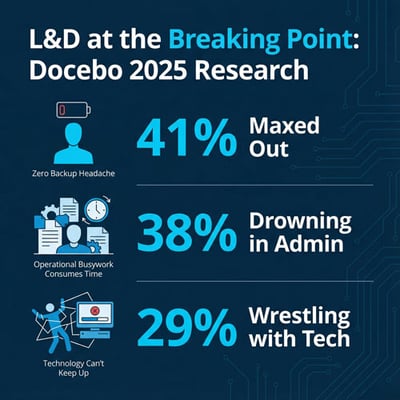
That reality shows up in predictable ways through capacity strain, fragile delivery, and workarounds that become normalized over time. These findings align closely with the signs we see repeatedly in practice and outline in 5 Warning Signs Your L&D Team Is Over Capacity. This is not a reflection of weak teams. It is a signal that most delivery models were never designed to scale live, human learning indefinitely.
Scaling fails not because people stop caring, but because the operating model depends on internal bandwidth alone.
Common failure points include:
- Inconsistent delivery standards across facilitators, producers, and regions. Session quality varies by cohort because expectations, preparation depth, and facilitation practices are interpreted differently as programs scale.
- Fragile run-of-show processes that rely on a few experienced individuals to prevent breakdowns. When those people are unavailable, last-minute fixes replace deliberate execution.
- Compressed preparation windows that reduce alignment, rehearsal, and refinement. Facilitators enter sessions with less context, producers have less time to anticipate issues, and small problems surface live instead of being resolved upstream.
- Limited visibility into capacity strain, making problems visible only after quality slips. Leaders see delivery counts, but not the warning signs that indicate when scale is starting to erode learner experience.
As these pressures build, connection is usually the first thing to suffer. Learners may not name it directly, but they feel the difference through uneven facilitation, rushed sessions, or experiences that vary by cohort or geography.
This is why disengagement is rarely a learner problem and is almost always a design, delivery, or capacity problem.
Why Live Learning Is at Risk Right Now
In today’s environment, the pressure to prioritize speed and cost is real. AI-generated content, self-paced modules, and automated learning systems promise efficiency at scale.
At the same time, leaders know, often intuitively, that mission-critical capability development does not happen through content alone.
Behavior change, judgment, confidence, and leadership presence develop through conversation, practice, and feedback because learning is inherently social.
Cheap learning scales output. Live learning scales capability.
The risk is not that organizations abandon live learning, it's that live learning is delivered without the structure required to protect quality and connection as it grows.
Where Scaling Breaks Down
Across virtual classrooms and hybrid programs, the pattern is consistent. When teams try to manage everything internally, delivery strain shows up in familiar ways:
- Delivery becomes reactive instead of intentional. Schedules shift, prep time shrinks, and handoffs become rushed.
- Quality erodes gradually. Nothing fails outright, but experiences vary more than intended.
- People compensate for system gaps. Producers stay late, facilitators stretch themselves thinner. and designers absorb rework.
- Leaders lose strategic visibility. Delivery continues, but improvement stalls.
Burnout is not the root problem here. Burnout is the symptom.
The underlying issue is structural. Live learning is being asked to scale without a delivery system designed to support it.
A Different Way to Scale Live Learning
Organizations that scale successfully make a clear shift. They stop relying on internal heroics and move toward a managed delivery system that protects human connection by reinforcing the roles, processes, and standards required for consistent live learning.
This is where Managed Learning Services comes in.
Managed Learning Services is not traditional outsourcing. It’s a long-term operating model designed to stabilize delivery while protecting quality and human connection, especially at scale. Certified facilitators, producers, instructional designers, and project managers operate within a single delivery model, with shared standards and accountability.
Instead of asking internal teams to absorb more, managed services provide:
- Specialized delivery roles that protect facilitator quality and learner engagement
- Repeatable processes for scheduling, preparation, and execution
- Clear service levels and visibility into capacity, risk, and performance
- Global consistency without sacrificing local relevance or human connection
The goal is not to replace internal expertise. The goal is to protect it, so internal leaders can focus on strategy, alignment, and continuous improvement rather than constant triage.
Proof That Scale and Humanity Can Coexist
At InSync Training, this model supports thousands of live virtual sessions each month across regions, time zones, and program types. The same approach has enabled global organizations to scale complex programs while maintaining consistency in real-world delivery environments.
When delivery becomes a system rather than a scramble, several things change:
- Rollout timelines become more predictable
- Delivery incidents decrease
- Learner experience becomes more consistent across cohorts
- Internal hours per session decline
Most importantly, learners experience live learning as it was intended: focused, engaging, and human.
This is how organizations scale without sacrificing the very element that makes live learning effective.
The Blueprint for Scaling Without Headcount
Every organization’s environment is different. Programs, platforms, regions, and internal roles vary.
That is why scaling live learning cannot be solved with a one-size-fits-all approach.
The Managed Learning Services Blueprint helps leaders see how a managed delivery model fits into their current ecosystem. It shows, step by step, how to strengthen capacity without diluting quality or connection.
The Blueprint outlines:
- Where capacity strain typically appears first
- Which delivery responsibilities can be shared without losing control
- How to protect quality and connection as programs expand
- What governance and service levels make scale sustainable
For leaders navigating growth without adding headcount, it offers a practical, low-risk way to move from recognition to design.
Where to Go Next
Leaders are under pressure to deliver learning faster and cheaper and many teams responded by scaling content.
But content is not capability.
When the work is mission-critical—onboarding, leadership, enablement, culture—organizations still need live learning that is consistent, well-run, and genuinely human. That is what builds confidence, judgment, and shared understanding, and is what makes a learning function credible.
Scaling that kind of live learning takes more than effort. It takes a delivery system built to protect quality and connection as demand increases.
If your team has stabilized but is unsure how to grow without repeating the last cycle of overload, start with clarity.
Build Your Managed Learning Services Plan
Watch or Register for our Webinar:
Inside the Managed Learning Services Model: Scaling Without Adding Headcount
→ See how the model works in practice, including real capacity constraints, governance decisions, and delivery trade-offs L&D leaders face at scale.
Download the Managed Services Blueprint
→ Use the step-by-step framework to assess your current delivery maturity, identify risk points, and determine whether a managed learning services model fits your organization.

1 min read
What a Real Managed Learning Services Partnership Looks Like
 Karen Vieth : Feb 16, 2026, 8:30:00 AM
1 min read
The Hidden Cost of Doing It All: Why L&D Teams Are Near a Breaking Point
 Jennifer Hofmann : Jan 5, 2026, 8:30:00 AM