1 min read
What a Real Managed Learning Services Partnership Looks Like
 Karen Vieth : Feb 16, 2026, 8:30:00 AM
4 min read

Last week, in The Hidden Cost of Doing It All: Why L&D Teams Are Near a Breaking Point, we explored the hidden costs of asking learning teams to deliver more than their systems and staffing can support. This week, we continue our Capacity Without Compromise series by shifting from awareness to diagnosis. Before you can protect quality and your people, you need a clear way to recognize the patterns that show your team is already stretched too thin.
Overcapacity rarely announces itself through a single issue. It more often shows up in the small moments: the prep deck that isn’t fully aligned, the facilitator handoff that feels rushed, the producer who stays on five extra minutes to fix something they never had time to address during the day. Individually, these moments feel manageable, but together, they signal the real cost of doing everything internally — a growing load the team can absorb only for so long.
Here are the five warning signs L&D leaders see most often and what they mean for your team.
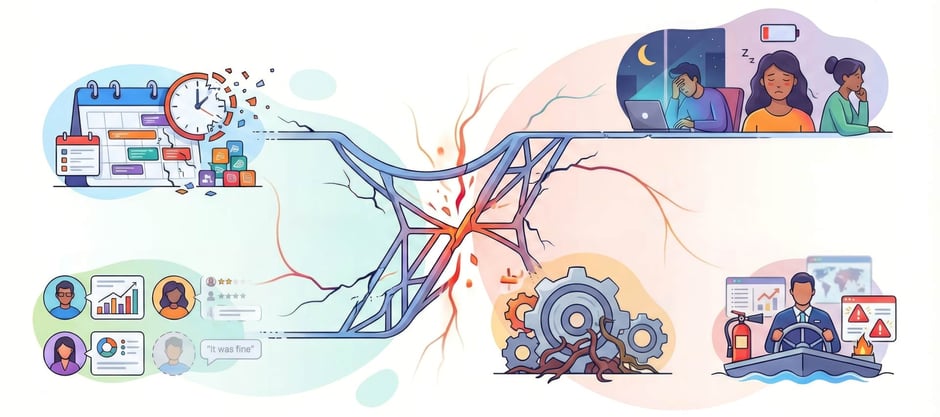
When demand outpaces capacity, operations are the first place cracks appear. Schedules shift, prep windows shrink, and coordination becomes reactive instead of intentional.
These indicators often appear when internal teams are trying to support every delivery, region, and cohort themselves:
These operational cracks don’t just affect delivery, they also spill into design timelines, project management flow, and implementation cycles, making it harder for the entire learning ecosystem to stay aligned. When this happens, learners feel the impact through uneven pacing, last-minute changes, or materials that weren’t fully ready for prime time.
Across hybrid and global programs, we’ve seen the same pattern: once two of these operational signals appear, a third usually follows within weeks. It’s not because anyone is doing something wrong; it’s because the system is quietly carrying more than it was designed for.
For a deeper look at how hybrid program complexity compounds operational strain, read our blog What Blended Learning Really Means – and How to Design It for Scale.
Quality rarely collapses all at once. It erodes in subtle ways through inconsistencies that learners notice even when leadership doesn’t.
Watch for:
Consistency often slips because design teams don’t have the margin to refine materials or coordinate timely updates, and project managers are juggling too many parallel initiatives to keep alignment tight. Most quality problems begin long before a session opens. They start in the preparation stage when the team doesn’t have enough time to review materials, align delivery plans, or adjust for different audiences.
As these pressures build, learners experience sessions that vary more than intended. Over time, inconsistency becomes a pattern rather than an exception. It’s one of the clearest early signals that capacity is tightening.
Behind every virtual classroom and module redesign is a human being balancing emotional and cognitive load. Overcapacity shows up here earlier than most leaders realize.
These signals matter most:
Instructional designers and project managers often feel this strain first. They’re navigating shifting timelines, reconciling competing priorities, and absorbing changes that weren’t planned for. Much of the work your team does to keep programs running smoothly is invisible. They notice the small breakdowns long before anyone else does.
When people begin compensating for system gaps instead of improving the learner experience, the strain is already well underway and your learners will eventually feel the variability.
You may hear someone say, “We’re fine; we just need a little more time.” In our experience, that’s usually the moment capacity is already slipping.
For strategies to support teams in hybrid environments, Essential Facilitation Skills for Thriving in Hybrid Learning offers a helpful foundation.
Across the portfolio, overcapacity creates strategic drag before leaders recognize what’s happening.
Typical indicators include:
Design cycles slow down, updates stack up, and project plans need constant revision. Even well-run initiatives lose momentum when each phase depends on people who no longer have the margin to plan ahead.
The learner experience suffers not from one big failure but from dozens of small delays that make every program feel slightly out of step.
Organizations often believe progress is steady because sessions are running, but what they don’t see is the effort required to keep the wheels turning. These hidden costs accumulate quickly when internal teams carry the full load alone.
These signals show that an L&D team has moved out of proactive strategy and into continuous triage:
Once design, delivery, and operations all move into reaction mode, leaders lose the ability to steer the learning portfolio strategically. Every decision becomes a workaround instead of a choice.
At this point, learners feel the variability: outcomes differ by region, cohort, or facilitator because the system is keeping up, not improving.
Across the field, workloads are rising faster than resources. More than half of L&D professionals report increasing pressure on their teams, and hybrid and virtual programs continue to expand without matching increases in staff. The pattern is clear: organizations are asking internal teams to deliver more than they can sustainably support.
Recognizing the signs early is essential. Most teams don’t lack the commitment, they lack margin.
This video offers practical starting points for reducing pressure in the areas you recognize most from the warning signs above.
You don’t need a full audit or a consulting engagement to understand your team’s capacity load. You simply need a baseline.
The Virtual Learning Capacity Scorecard helps you:
Identify hidden delivery bottlenecks
Assess team sustainability and burnout risk
Evaluate your ability to scale virtual programs
Understand where quality or consistency may be at risk
Determine whether your current delivery model can meet rising business demands
It takes only a few minutes and offers leaders a clear way to move beyond “we’re stretched thin” toward concrete insight. It’s a first step away from doing everything internally.
Your Scorecard results are just the beginning. Interpreting them is the next step.
InSync’s upcoming webinar, When Scaling Hurts: Why L&D Teams Burn Out (and How to Fix It), explores how capacity strain forms and what you can do to stabilize delivery, protect quality, and support your people without adding unnecessary burden.
Both the Scorecard and the webinar reflect this month’s focus on the cost of doing everything yourself and show how L&D leaders can move toward capacity without compromise.
Register for our Webinar: When Scaling Hurts: Why L&D Teams Burn Out (and How to Fix It)
Join InSync’s experts to explore why scaling hurts L&D teams and the practical steps you can take to prevent burnout in 2026.
Looking Ahead
Next week we continue the series by examining the patterns that create recurring capacity gaps and the practices that help L&D teams break the cycle while strengthening virtual learner engagement.

1 min read
Karen Vieth : Feb 16, 2026, 8:30:00 AM

1 min read
 Jennifer Hofmann : Jan 5, 2026, 8:30:00 AM