I've been in live training for twenty years. And right now, every facilitator I know is asking the same question: where does AI fit in what we do? Not as a theoretical exercise. As a practical one. Can I use it to design better scenarios? Can it handle Q&A in a virtual classroom? Will it replace me? Should I be worried or excited? Most of all: what can I actually rely on it to do?
Let me be direct. Some AI capabilities are game-changers for facilitation. Others are not ready. And some things AI will never do well because the work is fundamentally human.
First, scenario design. You give AI the business problem, the learner audience, and the learning objective. It generates realistic scenarios fast. Not perfect so you'll refine them. But it gives you a solid starting point instead of a blank page. A facilitator who used AI to draft five scenarios told me it saved her 8 hours of prep work. Then she spent 3 hours making them specific to her client's culture. That's a win.
Second, sample dialogue. When you're designing role-plays, you need starter scripts. AI can generate multiple versions of how a difficult conversation might sound—a customer complaint, a performance discussion, a conflict between team members. Again, you're not publishing what it creates. You're using it as a springboard. You make it real.
Third, post-session resource curation. After a training, people ask follow-up questions. AI can help you organize reference materials, create quick how-to guides, or draft answers to common questions. Your expertise shapes and filters everything. AI handles the legwork.
In all three cases, AI is your research assistant, not your replacement. You make the judgment calls.
What AI Can't Do (No Matter How Much We Wish It Could)
Now the hard part. There's work that only happens in the room, in the moment, with a human facilitator.
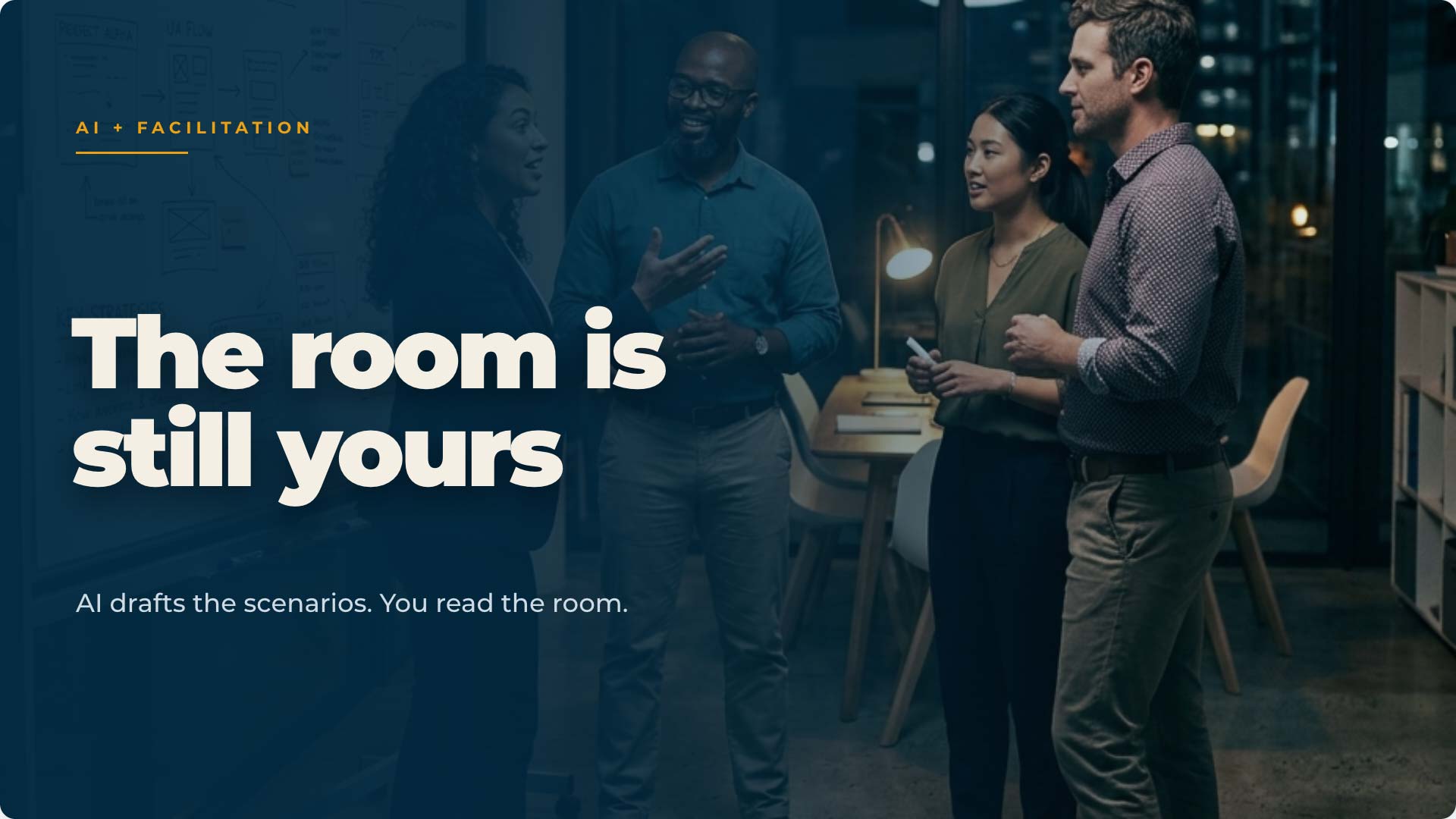
AI can't read the room. A participant goes quiet when you ask her opinion. She might be thinking deeply. She might be shut down. She might be dealing with something personal that has nothing to do with your training. You read her body language, her energy, the silence. You know whether to ask her again, move on, or check in later. That judgment is yours. AI doesn't have it.
AI can't respond to the unexpected. A question you didn't anticipate. A conflict brewing in the group. An insight someone shares that shifts the whole conversation. You respond in real time. You know when to lean into the moment and when to bring people back. You make thousands of micro-decisions based on what you know about learning and people.
AI can't build trust. People share real vulnerabilities in good facilitation. That happens because they trust you. They've watched you listen. They've seen you respect their time and their questions. They believe you care whether they learn. That relationship is earned over time, through consistency, through showing up. AI can't fake that.
The Real Opportunity for Facilitators
Here's what this actually means: facilitators who understand AI are more valuable, not less. Here's why. The work that AI can handle—drafting scenarios, organizing resources, generating options—that's work that keeps facilitators at their desks for hours. Work that drains energy without building capability. If AI handles that, facilitators have time and headspace for what only they can do, like reading the room, building relationships, and responding to what's actually happening.
A facilitator told me recently: "I spent two weeks building thirty scenarios. They were good. But I was exhausted and never left my desk to think about how people actually learn." If AI generates draft scenarios in a day, she has two weeks to think about learning design, to understand her audience, to imagine what might happen in the room and how to respond.
That's not replacement, it's a shift in what facilitation work looks like. Less admin, more judgment. Less content creation, more human connection.
What You Need to Learn
None of this happens on its own. You need to know what AI can do in your specific role. How to work with it. What to check. Which outputs need human validation. How to evaluate whether an AI-generated scenario actually works for your learning objectives.
This is the role capability question: can you use AI inside your facilitation work to drive better outcomes? Not to replace you. To amplify what you do. That requires training that's specific to your work, not generic "here's how AI works" courses. It requires knowing your workflows, your audience, your constraints. It requires judgment.
Start Here
If you're feeling uncertain about AI and facilitation, that's normal. The questions you're asking—what can I use this for? What should I never trust it with? How do I stay the thing that matters most in the room?—those are the right questions. Don't wait for answers to appear. Assess where you actually stand and what you need to learn.

 Jennifer Hofmann : Oct 5, 2026, 8:45:01 AM