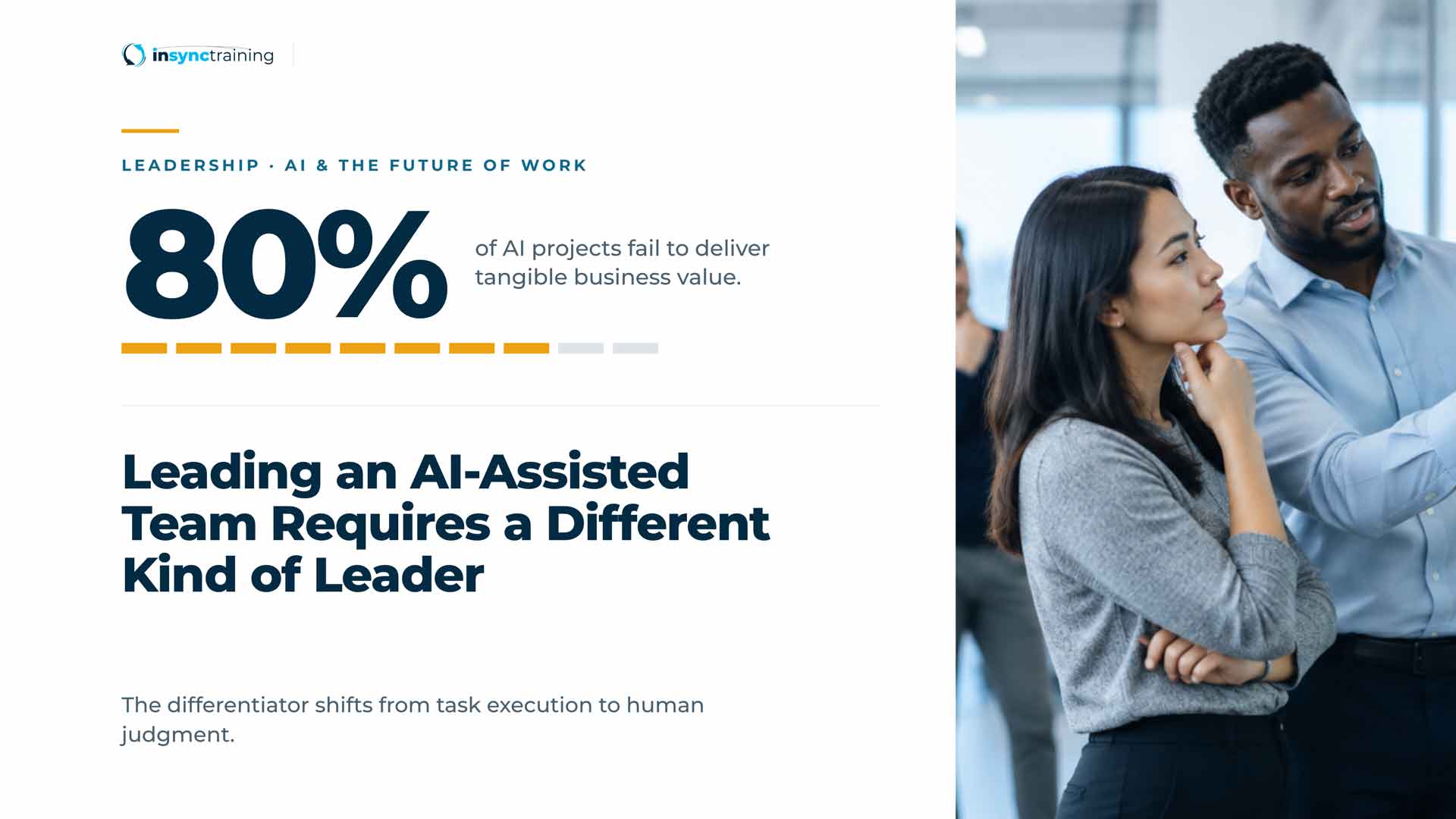
Eighty percent of AI projects fail to deliver tangible business value.
The AI Value Gap
- 80% of AI projects fail to deliver tangible business value.
- The challenge is rarely the technology itself—it's the human systems surrounding it.
As AI handles transactional work—drafting, data processing, pattern detection—leadership shifts too. It's no longer about workflow management. It's about orchestrating a human-plus-AI system. Building trust in uncertainty. Coaching through judgment calls the technology can't make. Knowing what to automate and what to defend as human work.
This requires a different leadership mindset.
What the Market Is Telling Us
PwC's 2026 Global AI Jobs Barometer contradicts the 'AI will replace people' narrative: organizations are reporting increased demand for human judgment, creativity, and leadership. Not less. The skills that matter most are the ones AI can't replicate. But here's the catch: they're also the skills many organizations haven't invested in developing.
They've realized something: as AI handles routine work, the differentiator shifts from task execution to human judgment, team trust, and a leader's ability to coach through ambiguous decisions.
The organizations hiring and promoting now want leaders who: build psychological safety on teams with both humans and AI, coach people through ambiguity, develop judgment in others, maintain ethical clarity when speed and cost push back, and orchestrate capability instead of just managing task completion.
Four Shifts in Leadership Practice
If you're a leader watching AI reshape your team's work, these four shifts matter most:
1. FROM WORKFLOW MANAGER TO CAPABILITY DEVELOPER
Leadership has chased efficiency: faster, leaner, less time. AI accelerates that dynamic. But it also exposes what efficiency leaves behind.
Create space for people to experiment and fail together. Coach them through decisions rather than making decisions for them. The outcomes are different when people develop judgment instead of executing instructions.
This isn't soft. It's strategy. A team with strong judgment and psychological safety outperforms one with high task velocity and low trust, especially in environments where the rules keep changing.
2. FROM RISK AVOIDANCE TO INTELLIGENT RISK-TAKING
In a stable world, leadership prioritizes consistency and predictability. But when technology is changing your work fundamentally, consistency becomes a liability. You need leaders who can create an environment where people experiment with AI, fail intelligently, and extract learning from failure instead of hiding it.
Set clear governance guardrails (what's safe?) and leave room for experimentation within them. Distinguish between acceptable failures (we learned something) and structural failures (data breach, untested bias). This distinction matters.
Without clarity, teams swing between reckless adoption and defensive paralysis. Neither serves the organization.
3. FROM INDIVIDUAL HEROICS TO DISTRIBUTED JUDGMENT
Many organizations were built on individual expertise: the brilliant designer, the experienced facilitator, the subject matter expert who everyone relies on. When that person leaves, capability walks out the door. When you rely on individual heroics, you can't scale.
AI forces this issue into the open. If your model depends on one person's expertise, you now have a real problem: that person can't possibly review all the AI outputs their team is producing. You have to move judgment out of one person and into the distributed capability of the team.
Make judgment development explicit. Create forums for collective decisions. Document the reasoning behind important calls so judgment becomes visible and learnable—not just individual insight.
4. FROM 'DO MORE' TO 'CHOOSE WHAT MATTERS'
AI accelerates production. Designers can generate more scenarios. Support Teams can manage more sessions. Facilitators can track more participants. And yet, the binding constraint isn't production. It's human attention and judgment.
Leaders who win with AI redirect that speed. They don't do more of the same faster—they do fewer things with higher impact. They ask: Which moments in this process actually require human expertise? Where does AI create risk if it's left unreviewed? Which decisions have high stakes and therefore require human judgment even if they could technically be automated? Then they concentrate human effort there and let AI handle the rest.
How to Build Trust When Everything Is Changing
When people don't understand why change is happening or what their role is going to be, anxiety rises. Fear of replacement is real. So is confusion about whether they'll have the skills to stay relevant.
The trust-building moves are not complicated. They're just not common:
-
Be explicit about what's changing and why.
Don't let people speculate. Say clearly: 'AI is going to automate this specific work. This is why. Here's what we're doing to make sure that creates opportunity for you, not displacement.' Then follow through.
Research from Dr. Jane Bozarth shows that organizations that laid people off and later rehired only rebuilt trust when they invested in people’s judgment and coached them through experimentation and failure.
-
Invest in judgment-building, not just AI literacy.
Generic AI training (how to use a tool) doesn't build the capability that matters. Role-based training that ties AI practice directly to job functions does. It signals that you're serious about people staying relevant.
-
Coach people through experimentation and failure.
Create space where people try AI approaches, make mistakes, and learn. When someone makes a decision that seems risky, ask about their reasoning instead of immediately stepping in. This is how judgment develops.
Ethical Leadership in an AI-Assisted World
There's a temptation to treat ethical questions as 'nice to have' considerations that come after deployment. That's a mistake. Some of the most important leadership work is insisting on ethical clarity even when it slows deployment.
Ask hard questions before implementation: Are we using AI to serve customers and employees, or primarily to reduce cost? Do we understand potential bias in our training data? What happens when the AI gets it wrong—how do we catch it? What's our responsibility to say it was AI?
In the current environment, organizations are getting credit for transparency and ethics that will be table stakes soon. Lead on it now, and you're not just building trust with your team. You're positioning your organization for the regulation and expectations that are coming.
Orchestrating Humans and AI
The best mental model for leadership right now is orchestration. You're not managing a team that happens to have access to AI tools. You're orchestrating a system that includes both human intelligence and artificial intelligence, with each playing the role they play best.
That means:
- Clarity on what each part does. AI handles analysis, drafting, pattern detection, and routine decisions. Humans handle judgment, relationship-building, ethical decision-making, and work that requires understanding context and competing values. Your job is to keep that division clear and defensible.
- Human oversight of high-stakes AI outputs. Not everything needs review, but the decisions that matter most do. A designer can quickly validate whether an AI-generated assessment measures what it's supposed to measure. A facilitator can review whether an AI suggestion for group intervention makes sense in this context. A producer can check whether an AI-moderated chat response actually addressed the learner's question. Your system should make that human review happen.
- Continuous learning and adaptation. You don't know yet how to do this at scale. Nobody does. The leaders and organizations that win are the ones who treat this as a learning project, not an implementation checklist. Experiment, capture learning, refine, and scale what works.
What Leadership Looks Like
To bring this into a concrete example: A design leader notices that teams are generating more course content faster with AI, but the learning outcomes aren't improving. Instead of pushing for more volume, the leader asks: 'What's the real performance gap we're trying to close? How much of that gap is actually knowledge, and how much is something else—confidence, job context, practice?' Together with the team, they shift from content speed to design strategy. They use AI to accelerate research and first drafts, but they concentrate human design effort on transfer problems: the moments where knowledge alone isn't enough.
That's orchestration. That's also the leadership that wins.
Start here: assess your team's readiness across four dimensions: AI literacy (do people understand how to work with these tools?), judgment development (can people make sound decisions about when to use AI and when not to?), governance clarity (do we have clear guidelines on data use, bias checking, and human review?), and capability architecture (are we investing in the human skills that matter most?). Get the Human-in-the-Loop Workflow Templates for frameworks on leading orchestrated teams.

 Karen Vieth
 Jennifer Hofmann : Oct 5, 2026, 12:00:00 PM