
1 min read
5 Delivery Gaps That Break Live Learning Quality at Scale
 Jennifer Lindsay-Finan : Apr 13, 2026, 8:30:00 AM
5 min read
 Jennifer Lindsay-Finan
:
Sep 21, 2026, 8:15:00 AM
Jennifer Lindsay-Finan
:
Sep 21, 2026, 8:15:00 AM
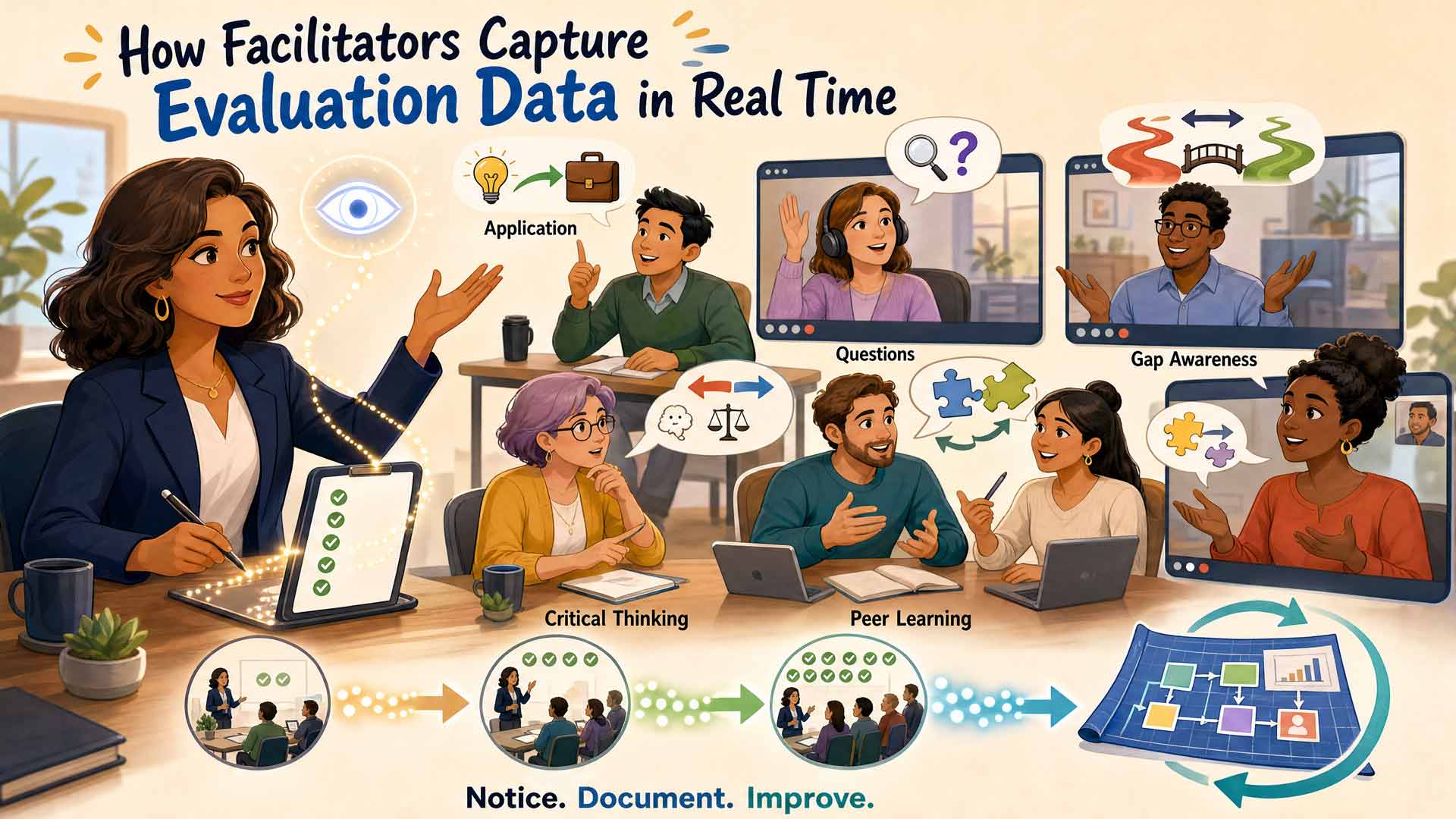
The best evaluation data in your entire program sits with the person who's actually running the session.
Facilitators watch what sticks and what doesn't. They hear the questions that signal deep thinking and the silence that signals confusion. They see learners lean in and check out. They know, in real time, whether the design is landing or falling flat.
And then, in most organizations, that data disappears. It lives in their head. It goes nowhere.
That’s where a simple observation protocol comes in. Not a heavy form. Not a task that pulls your attention during teaching. A framework that trains your eye to notice what matters, so you can document it after the session.
First: Facilitators are already observing. Right now, in this moment, you're watching learner reactions, reading energy, sensing when the room is with you and when it's not. Observation is part of teaching.
The question isn't whether to observe. It's whether you're going to systematize what you observe so it becomes evaluation data instead of just experience.
An observation protocol does exactly that. It tells your facilitators: Here are five behaviors that signal this learner is actually absorbing and applying the concept. Notice them. Document them. If you have a Producer supporting the session, they can capture those observations as they happen. If you're facilitating solo, make a note of them afterwards, when your brain isn't split between teaching and note-taking.
That distinction matters. You're not adding a task that pulls focus during delivery. You're creating a consistent way to document what you already see.
Let's make this concrete. Say you're running a program on difficult conversations for managers. Your learning objective is, ‘managers will use a specific coaching framework when addressing performance issues with their teams’.
What behaviors would tell you that learning is happening? What would the facilitator actually see?
Applying the framework to their own situation immediately, without being asked.
Asking how to handle specific, real-world scenarios rather than just absorbing content.
Discussing how their current approach differs from the new framework being taught.
Challenging the framework, which signals critical thinking instead of passive acceptance.
Teaching each other and building on each other's examples to increase retention.
When a manager applies the framework to their own situation, unprompted. They're not doing it because you asked them to. They saw how it works and immediately started thinking, "Oh, I could use this with my direct report who..." That's the signal you're watching for. Not everyone does it, but the ones who do? Document them.
When a manager asks a clarifying question about how to handle a specific scenario. This signals they're thinking about real-world application, not just absorbing content. They're mentally testing the framework against their own situation.
When managers discuss how their current approach differs from the framework. They're seeing the gap. That gap-awareness is where behavior change begins.
When a manager pushes back or challenges the framework. This signals critical thinking, not passive acceptance. Yes, they disagree. But they're thinking about it, not just nodding.
When learners interact with each other – teaching each other, building on each other's examples. Peer learning increases retention and transfer. These moments matter.
After the session, you note: "In this session, 8 of 12 managers applied the framework to their situation. Three asked clarifying questions about handling resistant direct reports. Two pushed back initially, then came around."
That's not a survey. That's not gut feel. That's actual behavioral evidence of whether learning is happening.
Here's why observation protocol data matters more than you might think.
When you ask a learner, "Will you use this framework in your role?" immediately after training, most say yes. They're still in the training mindset. Their intentions are genuinely good.
But do they actually use it? Here's the reality: Research from Saks & Belcort shows that only 30-40% of learners apply what they learn without reinforcement. That's not a training failure. That's how learning works. But it means post-course surveys saying "I'll use this" don't tell you much.
Research from Saks & Belcort shows that only 30-40% of learners apply what they learn without reinforcement. This isn't a training failure; it's how learning works.
This is why real-time observation is critical to predicting actual transfer.
When you observe whether learners were actively thinking about application during the session, whether they asked questions revealing they were working through how to implement it, you're getting a much stronger signal of whether transfer will actually happen.
You're not guessing. You're watching the behaviors that predict transfer.
And here's what else: That data tells you something no post-course survey can. It tells you what part of your design is working. Did learners engage with the framework? The data says yes or no. Did they see the relevance? Their questions tell you. Did the examples land? Watch whether learners started building their own examples on top of them.
If your design doesn't land in real time, no survey will tell you how to fix it. But observation will.
There's another signal you'll notice when facilitators are trained to observe: peer interaction. When learners engage with each other – teaching each other, building on each other's examples, asking each other clarifying questions – something different happens.
According to LINK: Brandon Hall Group's 2023 Learning and Development Benchmarking Survey, 77% of organizations report using collaborative learning techniques, and collaborative learning ranks among the top six most effective instructional modalities. There's a reason.
Organizations Using Collaborative Learning Techniques
*Source: Brandon Hall Group's 2023 Learning and Development Benchmarking Survey
When your design builds in peer dialogue, observation becomes richer. You'll see intellectual engagement deepen. You'll see application thinking move from "What would I do?" to "What would we do?" That peer collaboration changes the quality of the thinking.
That's why it matters to notice. Not just that collaboration happened, but how it shifted the learning.
The question every facilitator asks is: "How do I do this without slowing down my teaching?"
You don't. You separate the moments. During the session, you facilitate. During the transition to breakout, during lunch, at the end of the day, you spend three to five minutes documenting what you noticed. You're not writing essays. You're noting patterns.
"Eight managers applied the framework. Three asked clarifying questions. Two showed initial resistance, then shifted."
That takes exactly as long as it sounds.
The best facilitators are already doing this in their heads. A simple observation protocol just codifies what works and makes it repeatable across your facilitator team.
Here's what happens when you collect observation data from every live session:
Session one teaches you what's working. Session two builds on that learning. By session five, you know exactly which scenarios worked well, which examples stuck with learners, which parts of your design need revision.
You're not waiting for six months of data. You're not throwing away what you learned from session one because nobody documented it. You're building intelligence into the program with every delivery.
That's why the best live learning programs use facilitators as their primary evaluation data source. Not because post-course surveys are wrong. Because facilitators are closest to the moment of learning. They see what sticks. They see what questions reveal readiness. They see what learners will actually do.
If you're looking to strengthen your evaluation approach, start by giving your facilitators a framework to notice and document what they already see. Then use that data to design the next iteration better.
The Applying the Research guide walks through what a facilitator-based observation protocol looks like in practice. How to build it. How to train facilitators on it. How to translate that data into program improvements.
If you're moving evaluation from an afterthought to a design principle, that's where to start.
Tools and research to prove the business impact of your learning programs.
InSync's primary research on industry surveys and research-based best practices.
Read the ResearchPractitioner guide for translating evaluation research into actual practice.
Get the GuideUse the Virtual Facilitation Scorecard to document and improve performance.
Use the Scorecard🎧 Listen to the related podcast: Stop Measuring Attendance: Prove the Business Impact of Learning
1 min read
Jennifer Lindsay-Finan : Apr 13, 2026, 8:30:00 AM
1 min read
 Jennifer Hofmann : Sep 7, 2026, 8:30:00 AM
1 min read
Jennifer Hofmann : Sep 28, 2026, 8:30:01 AM