One training event doesn't move an organization's capability.
You can run the best designed two-day leadership program in the world. Show solid learning outcomes. See behavioral shifts in the room. And then watch the behavior revert to old patterns three weeks later because nothing in the system reinforced it.
The question isn't whether one session is good. The question is: "What system around that session makes results stick and compound over time?"
That's the difference between isolated training and learning that moves organizational performance.
The Live Learning Formula: Design That Compounds
At InSync Training, here's what we've learned works: Design the program to be repeated.
Not repetitive, but repeated. Design it knowing you're going to deliver it again, each time getting better data from the last iteration, each time refining the design based on what actually worked.
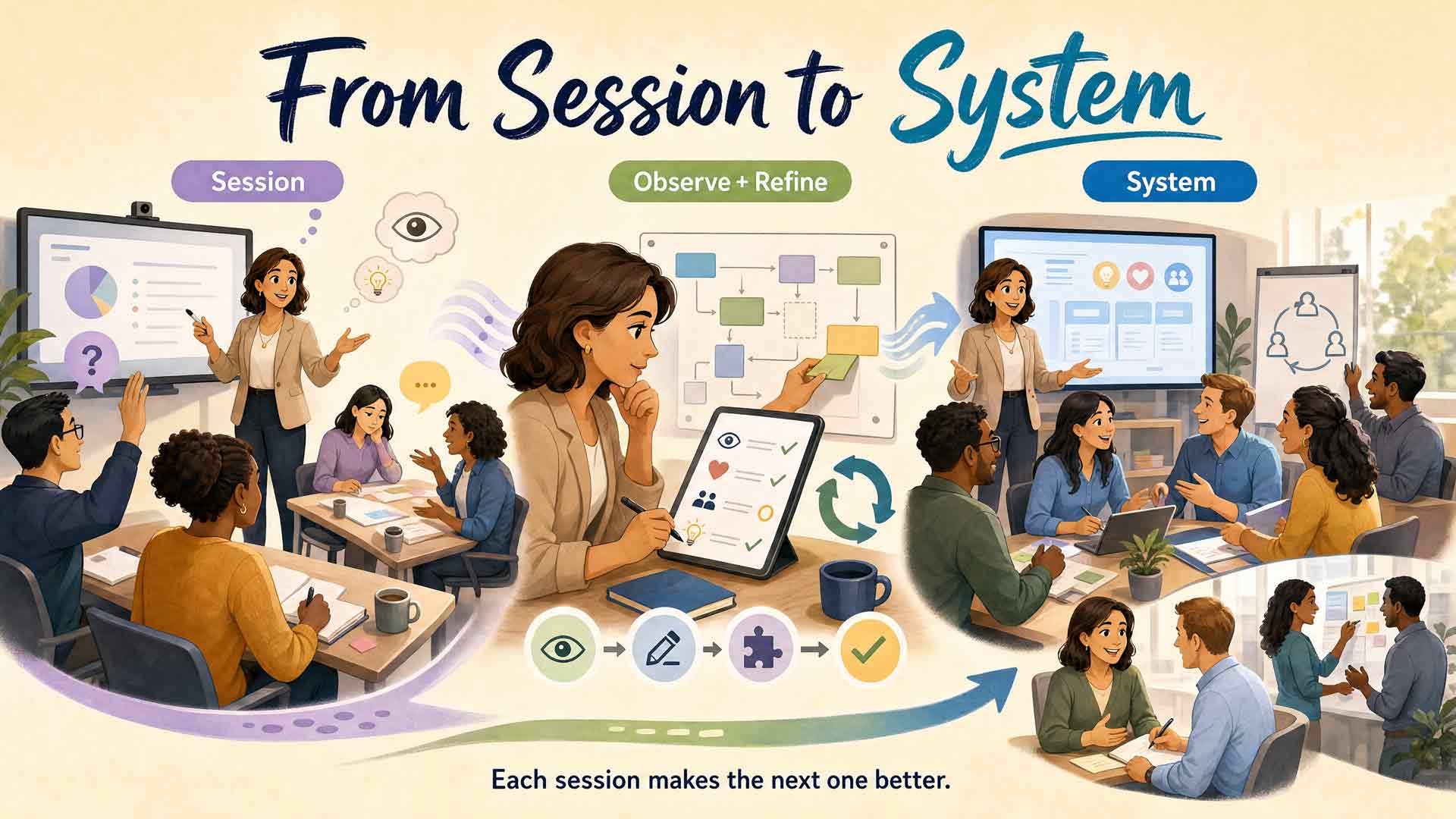
We call this the Live Learning Formula. It's simple:
That cycle – design, deliver, reflect, refine, repeat – is where sustainable impact lives. Not in the brilliant facilitation of session one. In the cumulative intelligence of sessions one through eight.
The InQuire Engagement Framework™: Three Dimensions of Meaningful Engagement
When you're observing what's actually happening in a learning program, you're watching for three dimensions of engagement that predict whether learning will transfer. We call this the InQuire Engagement Framework™.
All three dimensions are observable in real time while you're facilitating. When facilitators document which learners demonstrated all three across multiple sessions, patterns emerge. You learn which design elements drive all three dimensions, which drive two, which don't work. That data becomes your compass for the next iteration.
The Proof System: One Program Across Four Iterations
Here's a concrete example: Sales Leadership Training delivered four times over six months.
Iteration One: The program is solid, but observation reveals environmental engagement dips in the third module. Learners aren't building on each other's examples as the design intended. The issue becomes clear: breakout activity timing is tight, and facilitators are rushing it.
Iteration Two: You extend the breakout time by five minutes and brief facilitators on observing peer dialogue quality. Delivery two shows noticeably higher intellectual engagement as learners go deeper in each other's examples.
Iteration Three: A different pattern emerges. Sales managers less than two years in role show weaker emotional engagement. They're learning the framework, but they don't see themselves as leaders yet. You add a reflective exercise: "Where do you see yourself in five years? How does this capability get you there?" Iteration three shows stronger emotional engagement across all tenure groups.
Iteration Four: The program now runs smoothly across all three dimensions. Behavioral shifts observed in session hold three weeks later because learners connected emotionally to the content, engaged intellectually with peers, and believed it mattered to their career path.
You didn't perfect it in session one. You built it over four iterations, each time using real observation data to inform the next design.
That's the difference between training that works once and training that produces lasting change.
The Context: Why Iteration Matters Right Now
Here's the industry reality making this more urgent than ever.
According to ATD's 2025 State of the Industry Report, organizations are giving employees an average of just 13.7 hours of formal learning per employee in 2024, which is down from 17.4 in 2023. That's a 60% decline since 2020. At the same time, organizations are spending an average of $1,254 per employee on learning, and that spend has remained relatively flat even as learning hours have dropped.
In other words, formal learning time is scarce. Every hour of learning has to count more. You can't afford to run a design twice and get it right on the third rewrite. You need to use observation to get it right faster. You need each session to build on the last one.
The pressure isn't just to run training. It's to make every hour of training move the needle on capability and business performance. That only happens through design that compounds, iteration that's data-informed, and systems thinking about what reinforces change.
Building From Session to System
The leap from "run a good program" to "build a learning system" requires three things:
One: Facilitators trained to observe. Not as researchers. As teachers who notice behavioral signals and document patterns that tell you whether your design is working.
Two: A reflection discipline. After every delivery, you pause and ask: What did we learn? What's the pattern? What do we change for next time? This becomes a shared practice, not an occasional task.
Three: Design flexibility. You sketch the program, knowing it will evolve. Facilitators aren't defending a fixed design against evidence. They're refining it based on what works. Your confidence comes not from nailing it perfectly in session one, but from having a system that keeps improving it.
That's the Live Learning Formula. When those three elements work together, individual sessions become a system. Observation becomes intelligence. Iteration becomes advancement. And results compound.
The Thread Forward: More Human, Not Less
Here's what's interesting about building systems this way: As the speed of change increases, as AI enters the picture, as skill demands shift faster, and as the pressure to prove impact grows, the more human the learning process needs to be.
The programs that prove impact reliably are built for humans, not just scaled for efficiency. They're designed by people who observe other people. They're improved through reflection about what actually connected with learners. They're built on connection: intellectual, emotional, and environmental.
The more AI does, the more human skill matters. Not less. And the more we need learning systems that build human capability sustainably, through iteration and observation and peer connection.
That's not a training trend. That's a competitive necessity.

 Jennifer Hofmann
 Karen Vieth : Mar 9, 2026, 8:30:00 AM

 Jennifer Hofmann : Sep 14, 2026, 8:15:00 AM

 Jennifer Lindsay-Finan : Nov 24, 2025, 8:30:00 AM