Most leaders can recognize a good live learning experience when they see one: the virtual classroom feels purposeful, the facilitator is not filling time, learners are practicing something that resembles the work they need to do after the session ends, and the technology supports the conversation instead of becoming the conversation.
The harder question is whether that quality can happen again next month, in another region, with another facilitator, for a different cohort.
Live learning often gets misunderstood because it's easy to treat a strong session as the result of a talented facilitator or a well-built deck. Both matter, of course. But in our work with global programs, one of the first patterns we see is that reliable outcomes do not come from isolated excellence. They come from a system that connects design, delivery, and continuity before anyone enters the room.
Live Learning Quality Depends on the System Behind the Session
A strong live learning system starts long before the calendar invitation goes out. It starts with design decisions that are tied to capability, not just content coverage. When the goal is behavior change, the session cannot simply explain the right answer. It has to give learners a place to try, compare, reflect, and adjust.
This typically shows up in very practical ways. In a strong system, the facilitator knows why an activity exists, not just which slide it appears on. The producer understands where learner interaction is essential, not just when to launch a poll. The leader reviewing the program can see how each design choice connects to a business outcome, rather than hoping the connection becomes visible later.
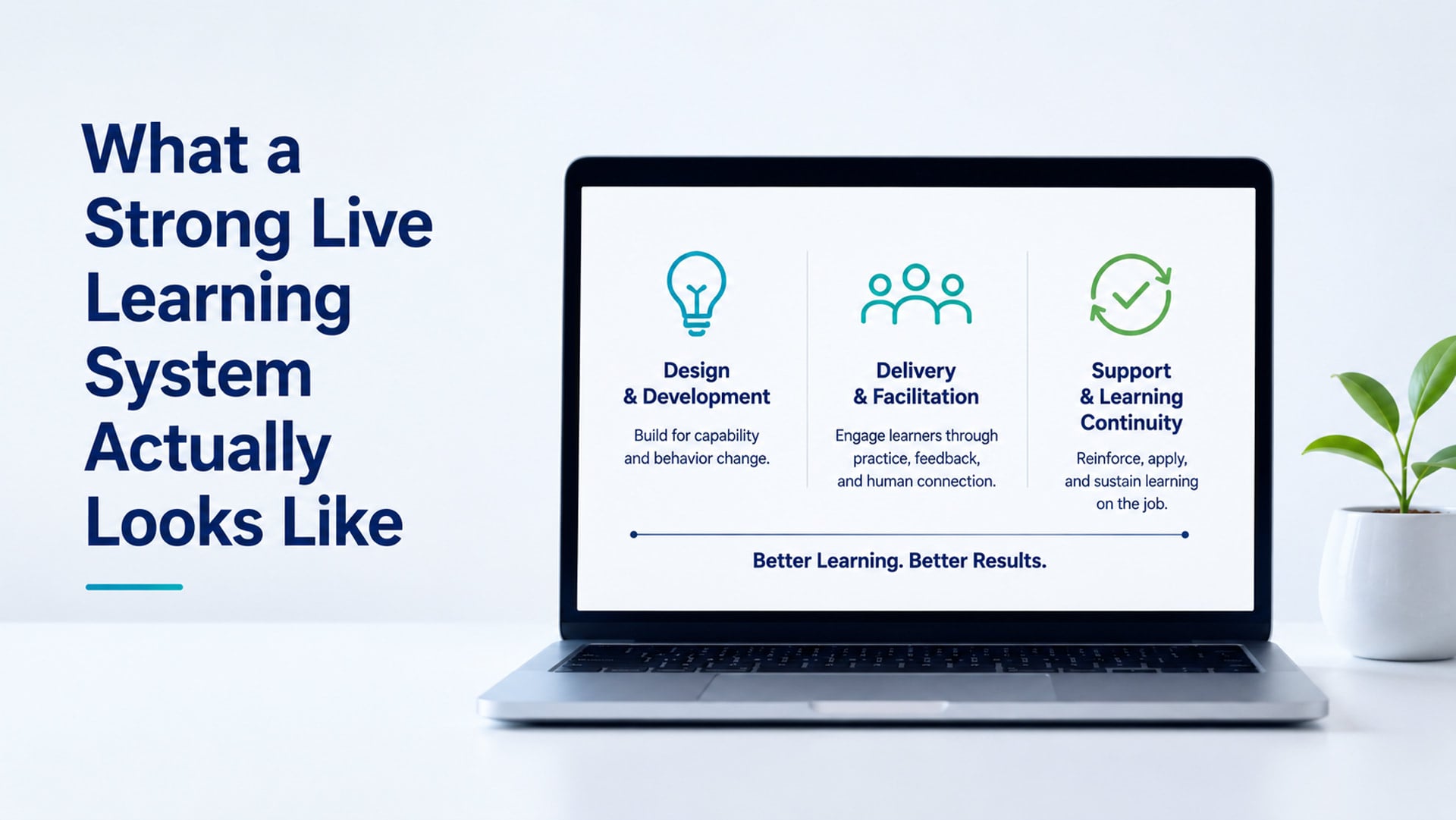
That is why InSync’s Live Learning Formula is useful as a leadership lens. Design & Development, Delivery & Facilitation, and Support & Learning Continuity are not separate workstreams that happen to touch the same program. They are interdependent parts of the same delivery infrastructure.
This systematic integration isn't just about operational neatness; it addresses a massive corporate pain point.
What Should Leaders Expect to See in a Strong Live Learning System?
When live learning is operating as a system, the evidence is visible and you'll see consistency without sameness. One cohort may have a different discussion than another, but the learning experience does not depend on whether a particular facilitator happens to know how to rescue a vague activity or interpret an unclear handoff.
A strong system usually includes:
Across large rollouts, this is often the difference between a program that scales and a program that simply repeats. Repetition means the same slides are used in Boston, London, and Singapore. Scale means the same standard of learner readiness, facilitator preparation, and outcome focus shows up in each location.
That distinction matters because live learning is premium. Not because it is more polished or more expensive, but because it uses the human advantage deliberately.
Learners can question assumptions, practice in context, hear how peers are solving similar problems, and receive feedback while the work is still fresh. Those moments are difficult to create in passive formats, and they are too valuable to leave to chance.
Where Strong Systems Reduce Risk
The risk in live learning is rarely that one session goes badly. The larger risk is variation leaders cannot see until it has already affected credibility. One region reports high engagement while another struggles to get participation. One facilitator preserves the design intent while another skips the practice activity to stay on time. One cohort leaves ready to apply the skill, while another leaves with notes and no confidence.
In complex virtual learning environments, these differences are usually not talent problems. They are system signals. The design may not have made the critical practice moments clear. The facilitator may not have received enough context to make sound decisions in the moment. The producer may have been brought in too late to identify timing, platform, or learner-access issues before delivery began.
A strong system reduces those risks by making quality observable. Leaders can look for shared standards, preparation workflows, run-of-show clarity, feedback loops, and post-session application support. Those are the places where live learning becomes measurable, not merely memorable.
What Leaders Should Examine Now
If your organization is investing in live learning, examine the system around the session. Ask whether design intent survives the handoff. Ask whether facilitators and producers are prepared to create human connection, not just manage airtime. Ask whether learners have a clear path from practice in the virtual classroom to performance on the job.
For a deeper look at why live learning deserves strategic investment, download our Why Go Live White Paper. It presents the research, business rationale, and practical framework leaders can use to evaluate live learning as a system rather than a standalone event.
This white paper is designed to help L&D leaders build a stronger case for live learning by connecting engagement, practice, facilitation, and learning continuity to measurable business outcomes. It also provides practical guidance for evaluating the strength of your current live learning ecosystem and identifying opportunities to improve learning effectiveness, behavior change, and business impact.

 Jennifer Hofmann
 Karen Vieth : Apr 20, 2026, 8:30:00 AM

 Jennifer Hofmann : Aug 3, 2026, 7:00:01 AM