A manufacturing company implemented an AI knowledge base to replace what had been a thriving community of practice. Engineers could now search for solutions, find troubleshooting steps, and access best practices instantly. The system was efficient...but after six months, the metric that mattered most started to slip: innovation. Fewer engineers were proposing new approaches, quality improvements slowed, and retention began to decline among the most senior people.
What they'd lost wasn't information access. It was the peer discussion where someone says, 'I tried that and here's what happened,' and another person responds with a different approach, and suddenly someone else in the conversation realizes a third option nobody had thought of. That's not knowledge transfer. That's thinking together. You can't automate it.
Communities of practice are how organizations develop and retain judgment. Not through individual learning, but through shared problem-solving, visible expertise, and the trust that comes from working through something hard with colleagues.
What Makes Communities Work
In Bringing More Human Presence, Dr. Jane Bozarth describes what social infrastructure in an organization requires: networks (people who connect across silos), communities of practice (people who solve shared problems), working out loud (people making their thinking visible to colleagues), and culture (norms that support experimentation and psychological safety).
Notice what's missing from that list: algorithms. Community infrastructure isn't a system. It's a set of deliberately designed interactions and relationships. And while AI can support some of what happens (it can transcribe conversations, surface patterns, send reminders), it can't create the trust or the stakes that make people willing to share what they really think.
Bozarth calls this the Interaction Multiplier: the value created when people learn with and from one another. Through conversation, feedback, shared problem-solving, and observation, learners develop judgment, uncover practical know-how that rarely appears in formal content, and build the trust and connections that support ongoing learning.
What Community Facilitation Means
Facilitating a community of practice isn't about delivering content or moderating discussion in a detached way. It's about creating the conditions where peer expertise becomes visible, where people feel safe to struggle and learn from colleagues, and where the collective thinking of the group strengthens.
That means asking the right questions, not providing all the answers. Inviting people to bring real problems and not hypotheticals. Making sure quiet voices get heard. Noticing when someone's expertise would strengthen someone else's thinking and connecting them. Creating the psychological safety where a senior person can say 'I'm stuck' without losing credibility.
This kind of intentional connection-building is increasingly becoming a core capability for L&D, as we explored in our post How Learning and Development Can Support Connection.
What This Looks Like in Practice
InQuire Engagement Framework™ Anchor:
- Emotional: Do people feel safe bringing real struggles and learning from peers?
- Intellectual: Are they learning from each other's thinking, not just getting answers?
- Environmental: Is the design supporting connection across the community or isolating people into individual tracks?
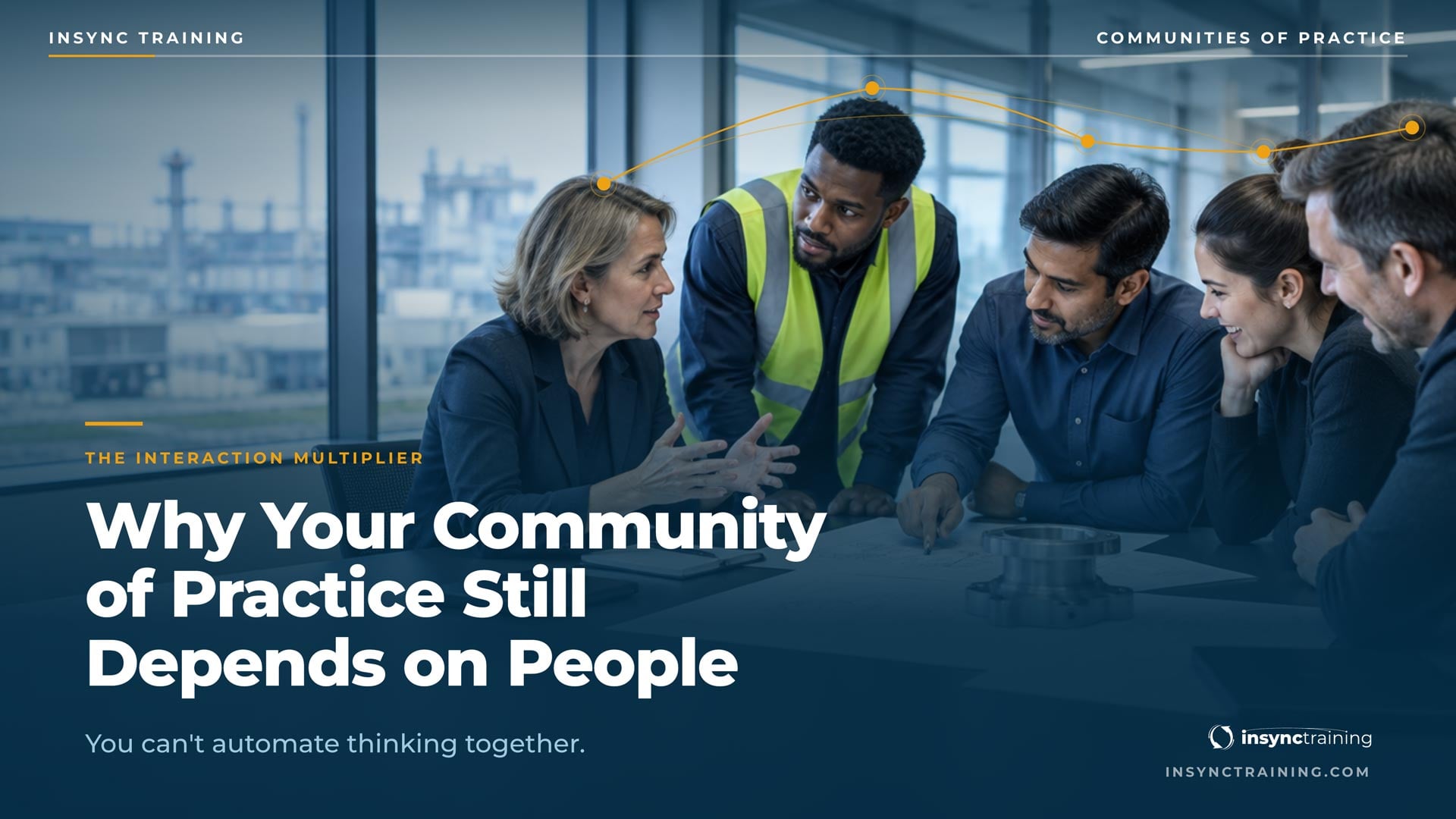
A manufacturing engineer brings a problem nobody's solved before. The facilitator doesn't route them to a knowledge base. Instead, the facilitator brings the question to the community. Other engineers share what they've tried. Someone realizes there's an analogous problem from a different context. Conversation surfaces a principle the first engineer had missed. They leave not with a solution but with thinking. And the problem becomes part of the collective intelligence of the community going forward.
Why Community Matters More Now
As AI floods learning with generic, quickly produced content, the counter-current is clear. Researcher Johannes Sundlo has been flagging this: machine-generated volume without judgment is 'slop.' The antidote isn't more systems, it's more human spaces where judgment develops through shared thinking.
Communities of practice are irreplaceable. They can't be scaled through content. They can't be automated. They're also the places where people feel most connected at work—where learning becomes an experience of belonging, not an obligation.
Next Steps
If your organization has communities of practice, invest in facilitation. If you don't, build them. Start with a shared problem your people actually care about, and design for the conditions where peer thinking becomes valuable. Get the Human-in-the-Loop Workflow Templates for frameworks on facilitating human-centered communities.

 Jennifer Hofmann : Nov 9, 2026, 8:30:01 AM

 Karen Vieth : Oct 27, 2025, 8:00:00 AM